
 Pearl
Pearl Zylo Ecosystem
 Sui
Sui Starknet
 Pons
Pons NEAR Protocol
 Quantus

Tether’s business model came under new scrutiny this week after Arthur Hayes warned of solvency risks.
This prompted strong reactions from industry figures who argued that Tether remains well capitalized and dominant in the stablecoin market.
Reactions Grow After Arthur Hayes Forecasts Pressure on USDT
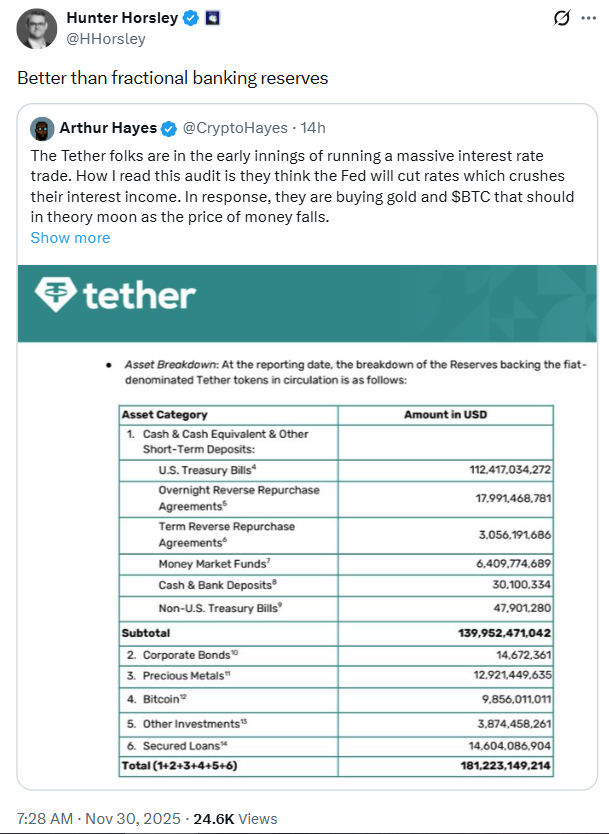
The discussion began when Arthur Hayes shared his view that Tether could face pressure if falling United States interest rates reduce its interest income.
In his post on X, Hayes said Tether has increased its exposure to gold and Bitcoin.
According to him, a decline of about 30% in those assets could erase the company’s equity and raise insolvency concerns.
He added that some large holders might request real-time balance sheet data to assess risk.
Interestingly, industry voices responded quickly. Bitwise CEO Hunter Horsley said Tether’s structure is better than fractional banking reserves.
Furthermore, researcher Joseph, who wrote an extensive analysis on Tether for Citi, added detailed counterpoints.
According to him, Tether only discloses reserve-matching assets and does not reveal its full corporate balance sheet.
He said the company also holds equity investments, mining operations, corporate reserves, and possibly more Bitcoin.
Joseph said Tether generates significant profit from its holdings of approximately $120 billion in short-term United States Treasury securities.
He estimated that these assets have produced about $10 billion in annual profit due to yields near 4% since 2023. He said this makes Tether highly efficient with a lean workforce.
The expert suggested that the value of Tether equity could fall between $50 billion and $100 billion.
As noted, Tether explored a capital raise of $20 billion for 3%, although he said such a valuation might not materialize.
Joseph compared Tether reserves to the banking system. In his words, banks typically hold 5% to 15% of deposits in liquid assets.
Meanwhile, Tether holds far more liquid backing and operates without a central bank as lender of last resort.
What Arthur Hayes Missed, According to Analysts Defending Tether
Supporters said Hayes did not address the difference between Tether’s reserve disclosures and its broader financial resources.
For example, Tether uses a matching approach in its reserve reporting and does not include its separate corporate equity balance sheet.
It was also detailed that, the Stablecoin issuer could sell equity to fill balance sheet gaps if needed.
Market participants also emphasized that Tether does not operate like a traditional bank but holds a higher level of collateralization.
It was argued that Hayes focused on asset price volatility but did not factor the company’s profit stream.
In addition to ongoing dividends, and additional corporate assets that could support reserves.
Basically, this creates a stronger financial position than his scenario suggested.
Furthermore, supporters suggested that the company might withstand interest rate fluctuations because its reserve structure and profitability provide additional flexibility.
USDT Retains a Leading Role in the Stablecoin Market
According to CoinMarketCap data, Tether remains the largest stablecoin by a wide margin.
The latest data shows USDT at about $184.6 billion in market capitalization.
CoinMarketCap detailed that daily volume is more than $56 billion, almost matching the circulating supply that stands at about 56.04 billion USDT
USDC follows at about $76.55 billion in market capitalization, with far lower daily volume.
Other notable stablecoins include Ethena USDe at $7.19 billion, Dai at $5.36 billion, PayPal USD at $3.87 billion, and World Liberty Financial USD at $2.69 billion.
Despite recent debates, USDT remains the most liquid and widely held stablecoin, underpinning its central role in cryptocurrency markets.
In related news, Tether has recently added 961 Bitcoin, worth $98.9 million, to strengthen its reserves. This further adds to the argument for a more positive outlook for Tether.



