
 Sword Inu
 no crying in the casino
 streamoors
 IGNITION
 Altai the Tiger
 Pearl
Pearl Quantus
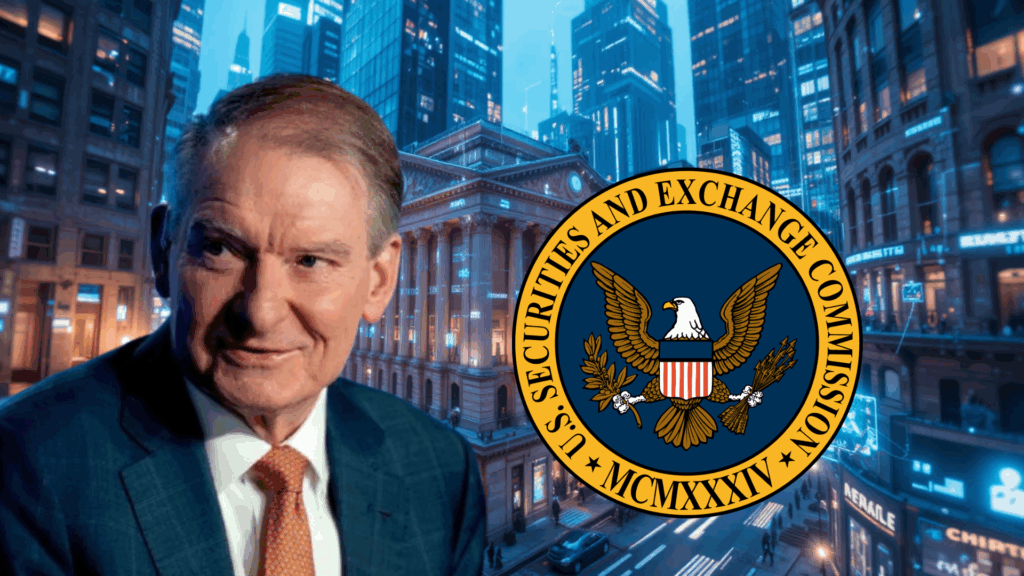
U.S. Securities and Exchange Commission chair Paul Atkins said all U.S. markets would move on-chain within two years.
He spoke on the pace of tokenization and digital settlement, according to CryptoGoos.
The statement marked one of the clearest timelines ever given by a U.S. regulator on blockchain adoption.
It framed on-chain infrastructure as an outcome, not a proposal still under debate.
Atkins said the shift would encompass trading in equities, bonds, and derivatives.
He added that blockchain rails would replace large parts of today’s clearing and settlement stack.
Regulator Puts Timeline on Full Market Tokenization
CryptoGoos reported the remark as breaking news minutes after the statement appeared online.
The post quoted Atkins saying “all U.S. markets will be on chain within two years.”
The message placed a deadline on a process Wall Street already tests in limited pilots.

Tokenized treasuries, on-chain repo, and digital settlement already operate in closed environments.
The tone differed from earlier regulatory caution.
Atkins framed tokenization as an execution phase rather than an experimental trend.
The Bitcoin Historian later expanded the context.
He quoted the SEC chair saying the entire financial system would run on Bitcoin and crypto within a few years.
“It’s the way the world will be,” The Bitcoin Historian wrote, attributing the words to Atkins.
The post aligned blockchain infrastructure with long-term financial system plumbing.
Markets often react sharply to timeline-driven regulatory shifts.
However, Atkins did not tie the statement to deadlines for rulemaking or enforcement updates.
Bitcoin Framing Collides With Regulatory Architecture
The same comments framed Bitcoin as a core settlement layer, not just a speculative asset.
That angle pushed the debate beyond exchange listings and exchange-traded products.
The description of “the entire financial system” running on crypto implied broader integration.
That would include payment rails, securities issuance, derivatives clearing, and custody.
This position would shift how regulators define market infrastructure.
It would also recast the role of centralized intermediaries across clearing, settlement, and custody.
Atkins did not reference price levels or market capitalization.
His remarks focused on systems architecture rather than asset valuation.
Traders still read the statement as structurally bullish for digital assets.
However, price moves tied directly to the comments did not appear immediately.
The lack of immediate volatility reflected uncertainty over execution risk.
Traders often price narratives only after policy follow-through becomes visible.
Ron Paul adds Tax and Regulation Pressure to Bitcoin Debate
Separate comments from Ron Paul intensified the political side of the discussion.
Trending Bitcoin quoted him saying Bitcoin “shouldn’t be regulated by the government and it shouldn’t be taxed.”
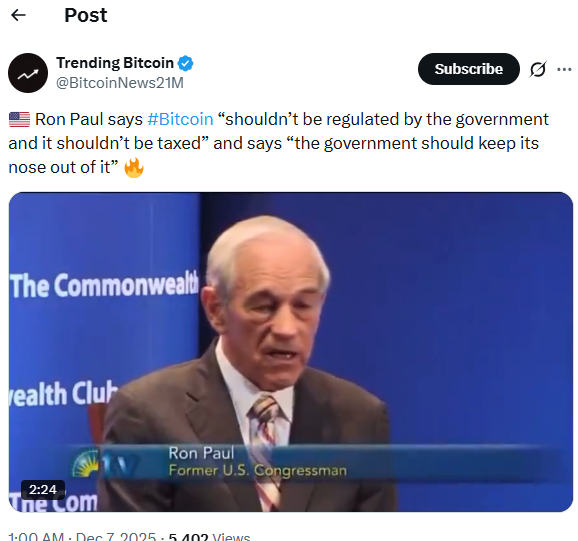
Paul added that the government should “keep its nose out of it.”
His remarks echoed long-standing libertarian arguments on monetary sovereignty.
The comment did not connect directly to Atkins’ on-chain timeline.
However, both statements converged on the idea of reduced state control over money infrastructure.
Paul’s position contradicted current U.S. tax treatment of digital assets.
The Internal Revenue Service still treats Bitcoin as taxable property.
The gap between regulatory practice and political rhetoric remains wide.
No current bill removes capital gains obligations from digital asset transactions.
On-chain Markets Already Test Regulatory Limits
Tokenized U.S. Treasury products already circulate on blockchain networks today.
Firms issue digital representations of government debt for on-chain collateral use.
Wall Street banks also test on-chain settlement for repo and cross-border payments.
Those pilots reduce settlement risk by compressing clearing cycles.
However, public blockchains still face scalability and compliance limits.
Know-your-customer rules and sanctions enforcement remain regulatory choke points.
Atkins’ comments implied that compliance would migrate alongside infrastructure.
He did not specify how regulators would monitor decentralized settlement at scale.
Market structure rules still assume centralized clearinghouses.
On-chain settlement challenges that model by design.
Regulatory Clarity Remains Uneven Despite the Rhetoric
The SEC still litigates several digital asset classification cases.
Atkins’ comments did not address how existing disputes fit into the two-year vision.
Congress continues to debate stablecoin and market structure bills.
Those laws could define how tokenized markets operate inside federal oversight.
The timeline proposed by the SEC chair now acts as a public benchmark.
It exposes regulators to credibility risk if execution stalls.
The Bitcoin Historian’s framing that the entire system would run on crypto raised expectations further.
That narrative now competes with slower legislative and supervisory processes.
Ron Paul’s tax comments added ideological force without legal backing.
No current federal policy supports his position.
Market Impact Hinges on Enforcement, Not Speeches
Speeches alone rarely drive sustained structural re-pricing.
Traders typically wait for enforcement actions, exemptions, and rule changes.
Atkins’ on-chain timeline offered direction but not detail.
Without a public roadmap, market participants still face regulatory uncertainty.
Bitcoin and broader crypto markets already price in gradual institutional integration.
Full on-chain migration would exceed most base-case models.
For now, markets treated the remarks as confirmation of a long-term trend.
Short-term risk appetite still depended on liquidity, rates, and macro positioning.
The U.S. government now carried a public two-year clock on market tokenization.
Whether that clock reflects policy reality remains unresolved.



