
 Bitcoin
 ZKsync
 Pudgy Penguins
 Pearl
Pearl Quantus
 Starknet
 NEAR Protocol

Spain will fully implement two major crypto regulations in 2026. This implementation will change how digital assets are traded and taxed in the country.
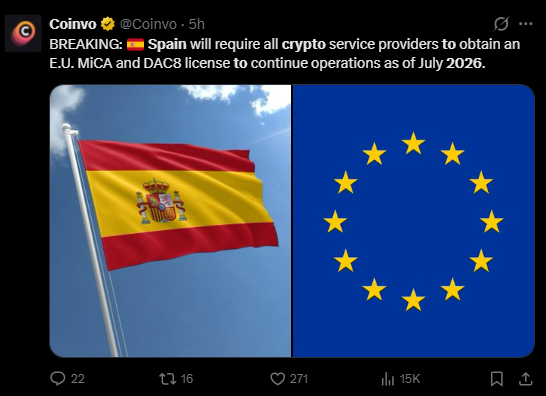
The MiCA Regulation will see complete deployment by mid-2026.. At the same time, the DAC8 directive takes effect on January 1.
The new framework will require companies to obtain authorization. It will also mandate automatic reporting of cryptocurrency transactions to tax authorities.
MiCA Regulation Sets July 2026 Deadline
The MiCA Regulation will reach full deployment in Spain by July 1, 2026. It became applicable across Europe on December 30, 2024.
The crypto regulation standardizes rules for cryptocurrency issuance and marketing across the European Union. It categorizes digital assets into three main types: utility tokens, security tokens, and stablecoins.
Spain’s National Securities Market Commission (CNMV) oversees the implementation. The agency has registered over 60 companies to operate with digital assets in the country.
Registered entities include banks such as Cecabank, Banco Bilbao Vizcaya Argentaria, and Renta 4 Banco, along with cryptocurrency exchanges.
The Spanish government implemented the full transition period in early December, extending it until July 1, 2026. The regime benefits firms that provided cryptocurrency services under the previous legal framework before MiCA approval.
The extension lets these companies keep operating under prior national regulations. They do not need immediate authorization under the new provisions.
From July 1, 2026, only companies with full MiCA authorization will be permitted to operate. Firms must achieve complete compliance with European standards or face closure.
DAC8 Directive Enables Direct Asset Seizure
The Administrative Cooperation Directive (DAC8) addresses the fiscal dimension of crypto regulations. Congress approved it in October 2025,
The directive takes effect on January 1, 2026. Exchanges and service providers must automatically report user transactions, balances, and movements to EU tax authorities.
Reporting obligations cover sales, exchanges, and transfers, eliminating anonymity in regulated operations. Platforms must submit reports on 2026 transactions between January 1 and September 30, 2027.
José Antonio Bravo Mateu, a digital asset taxation specialist, stated that DAC8 expands the scope of information available to the Tax Agency. He noted that from 2027 onwards, authorities will have information on all transactions carried out during 2026.
The law grants the Treasury power to seize cryptocurrencies for tax debts. Bravo warned that, starting January 1, 2026, assets on exchanges in Spain can be seized directly. This will happen without complex prior procedures.
Tax Reporting Requirements Differ by Platform Location
Crypto regulations under DAC8 establish different reporting mechanisms based on platform location.
Regulatory consultant Cero Uno clarified that cryptocurrencies held by entities with tax residence in Spain must report directly to the Spanish tax authorities. Companies such as Binance Spain SL must use Forms 172 and 173 for this reporting.
Form 172 covers balances as of December 31. At the same time, Form 173 reports transactions carried out during the year. Both are mandatory information returns.
For foreign centralized exchanges within the EU, such as Kraken in Ireland, these national forms are not submitted to Spanish authorities.
Self-custody remains excluded from the reporting system. Cryptocurrencies kept in personal wallets are not considered located in Spain or abroad for tax purposes.
No third-party provider reports such assets in the aforementioned forms or in Form 721. It covers virtual currencies held in custody entities located abroad.




