streamoors
 Sword Inu
 Altai the Tiger
 IGNITION
 no crying in the casino
 NEAR Protocol
 Pudgy Penguins

Kansas lawmakers have introduced Senate Bill 352, a surprising move from a conservative state. The bill creates a reserve fund for digital assets without using taxpayer money. It amends unclaimed property laws to include cryptocurrencies like Bitcoin.
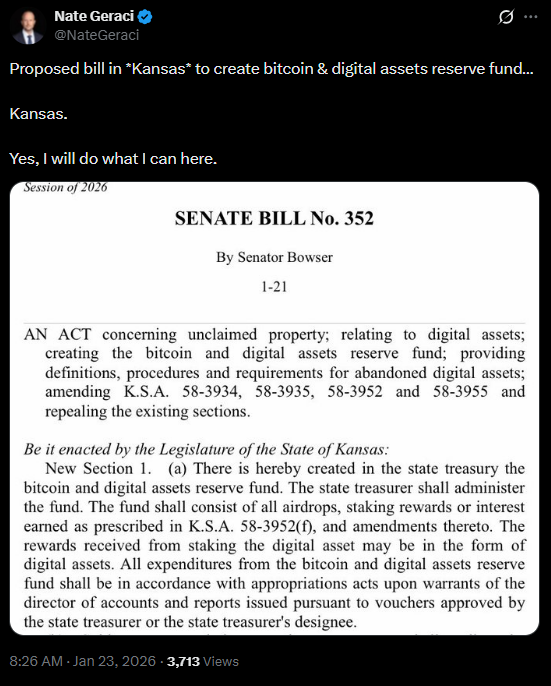
The state would hold unclaimed digital assets through custodians. Kansas could stake assets, collect rewards, and build reserves. This Bitcoin news highlights a passive strategy that avoids direct purchases and market risks. At the same time, it positions Kansas as a new player in crypto adoption.
Legislative Details
State Senator Craig Bowser introduced Senate Bill 352 on January 21, 2026. The measure advanced to the Senate floor the next day. It amends sections K.S.A. 58-3934 and 58-3935 to include digital assets such as virtual currencies, cryptocurrencies, and Bitcoin.
Under the bill, unclaimed digital assets that have been dormant for three years after failed owner notifications would escheat to the state. Kansas would hold them in native form through qualified custodians.
The framework allows staking, airdrops, and interest collection. These rewards would flow into the Bitcoin and Digital Assets Reserve Fund after an additional holding period.
The Kansas State Treasurer would manage the fund. Bitcoin receives special treatment. It cannot be sold or deposited into the general fund. It remains a long-term reserve.
Other digital assets may contribute up to 10% of deposits to the general fund, but only with legislative approval. This creates a potential revenue stream without touching Bitcoin holdings.
Bitcoin news: Key Terms and Community Response
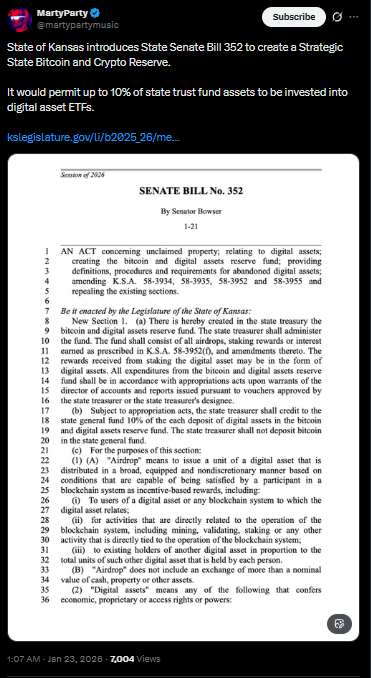
The legislation defines terms to support integration. An “airdrop” is described as a broad distribution of digital asset units as incentives for blockchain participation, excluding nominal exchanges.
“Staking” means committing assets to validate transactions and secure networks. “Digital assets” include any asset that confers economic or proprietary rights.
This Bitcoin news shows Kansas adapting its unclaimed property rules to the digital era. The approach is similar to how states handle abandoned bank accounts or stocks.
Kansas could build its holdings organically without making direct purchases. The passive strategy reduces the risks associated with volatility.
Social media reactions highlight enthusiasm. Crypto commentator MartyParty noted the bill’s potential to allocate up to 10% of state trust funds into Bitcoin ETFs. He described it as a “strategic state Bitcoin and crypto reserve.”
Another analyst pointed out the bill’s referral to the Senate Committee on Commerce. He noted that it joins states like New Hampshire and Texas in their adoption of Bitcoin. Ash Crypto called it “giga bullish,” stressing its role in broader U.S. crypto trends.
National Context and Bitcoin News Reactions
This Bitcoin news aligns with a surge in state-level initiatives during 2025–2026. It follows federal signals, such as President Trump’s executive order on a U.S. Strategic Bitcoin Reserve, which retains seized assets rather than auctioning them.
Kansas, known more for agriculture than technology, surprises observers by modernizing laws. The bill avoids direct purchases, lowering exposure to market swings. If passed, it could serve as a model for other states. Reserves would grow from unclaimed crypto while harvesting yields.
Critics raise concerns about security and regulatory hurdles. Supporters argue the bill hedges against inflation and could attract tech investment to Kansas.
Currently, SB 352 awaits committee review in the 2026 legislative session. No major opposition has emerged. Its progress depends on bipartisan support.
This Bitcoin news marks another step in cryptocurrency’s mainstream integration. Kansas may reshape how state treasuries manage digital assets, setting a precedent for the nation.