
 streamoors
 Altai the Tiger
 Sword Inu
 IGNITION
 no crying in the casino
 Quantus
 NEAR Protocol
Key Insights:
- Supreme Court denies Coinbase user’s privacy appeal against IRS access.
- The IRS can legally obtain exchange user data without individual notice.
- Self-custody gains attention as centralized exchanges face legal scrutiny.
The U.S. Supreme Court rejected Coinbase user James Harper’s appeal against the IRS. This ends his long-standing challenge over the agency’s access to crypto exchange user data.
Harper accused the IRS of violating his Fourth Amendment rights. He claimed the agency tried to access his Coinbase trading history without obtaining a warrant.
The Court denied the appeal. However, it did not explain its basis in writing, upholding a decision of a lower court in favor of the IRS.
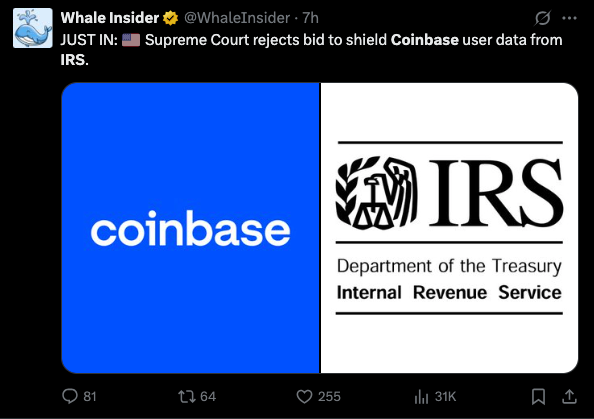
The Court confirmed that the IRS can legally request financial data from platforms like Coinbase. It can use a method called a John Doe summons to do this. This tool allows agencies to gather user records from third parties. They don’t have to name the specific individuals being investigated.
The Court’s denial backed the earlier ruling from the lower Court. It said the financial data belonged to Coinbase as a business, not to Harper personally.
Since Coinbase is just licensed in the EU, Harper’s rights didn’t apply. That meant constitutional protections didn’t cover those digital records held by intermediaries.
IRS Granted Access to Coinbase User Data
The case dates back to 2020, but its roots trace to 2016. That’s when the IRS began sending broad summons to Coinbase for user information.
They suspected some users were hiding crypto income from taxes. Even after narrowing it to around 14,000 accounts, the request still included login times, profile details, and transaction history.
Harper argued that the company’s cache of downloaded files represented an unconstitutional search and seizure. He believed his rights were violated when that data was collected without a proper legal process.
He also, using the support of privacy advocacy groups, urged the courts to revisit the antiquated third-party doctrine. It’s a legal finding informed by the U.S. v. Miller decision of 1976.
The doctrine says people give up privacy rights to data they voluntarily share with third parties. This includes info shared with banks or online platforms.
Nevertheless, the legal system was also on the side of the IRS. According to the decision of the First Circuit Court of Appeals, the data did not belong to the user.
Coinbase had already informed users in its privacy policy that it might share data with authorities. Because of this warning, the Court found no Fourth Amendment violation.
Coinbase Under Regulatory Pressure
The decision comes when Coinbase is going through a wider legal assault. In April, the state of Oregon sued the exchange. They charged it with profiting by selling high-risk and unregistered securities, adding to its long list of legal disputes.
The state is seeking penalties and the return of any profits made. It has teamed up with law firms Keller Rohrback and Cohen Milstein to pursue the case as a class action.
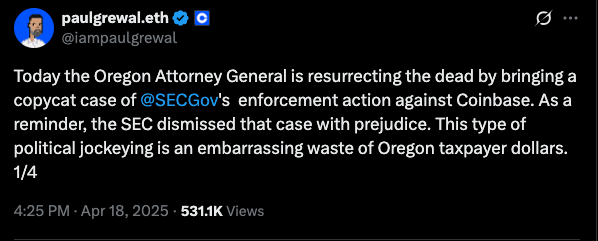
This complaint criticizes Coinbase’s practices and accuses it of infringement of the Anti-Securities Law of Oregon. Also, it is required to pay a fine of $20,000 per infringement.
On its part, Coinbase has kept denying wrongdoing. It advises that litigation across state lines will likely break up the crypto industry and kill innovation.
Coinbase VP of Legal, Ryan VanGrack, claimed the state of Oregon is acting out of political motives. He suggested the case is more about politics than legal wrongdoing.
The Oregon case began two months after the U.S. SEC dismissed a similar complaint. That earlier dismissal happened during the Trump administration. The SEC suit alleged that Coinbase would facilitate trade in at least 13 unregistered digital tokens.
Disclaimer
This article is for informational purposes only and provides no financial, investment, or other advice. The author or any people mentioned in this article are not responsible for any financial loss that may occur from investing in or trading. Please do your research before making any financial decisions.




