
 astronaut
 Pearl
Pearl NEAR Protocol
 Walrus
 Zylo Ecosystem
 Bitcoin
 Hyperliquid

Bitcoin exchange reserves have plummeted to approximately 2.4 million BTC. This is the lowest level in over a decade, according to data from CryptoQuant.
The metric represents coins held on centralized exchanges available for immediate trading. The drop also shows the reduced sell pressure and continued accumulation by long-term holders.
Analysts identify the correction as a leverage-driven event rather than a broad capitulation.
Exchange Reserves Hit 2.4M Bitcoin, Creating Supply Tightness
Bitcoin held on centralized exchanges has dropped to about 2.4 million BTC. This is a decrease from over 3.5 million BTC in 2020. The reduction is one of the longest and most consistent outflow trends in Bitcoin’s history.
Chairman Lee, a professional analyst at CryptoQuant, characterized the development as indicating “a supply-side shock in progress.”
The drop is the lowest exchange reserve level since before the 2017 bull market, when centralized exchanges were expanding quickly. From 2013 to 2018, reserves rose sharply as exchanges grew and new liquidity entered the market.
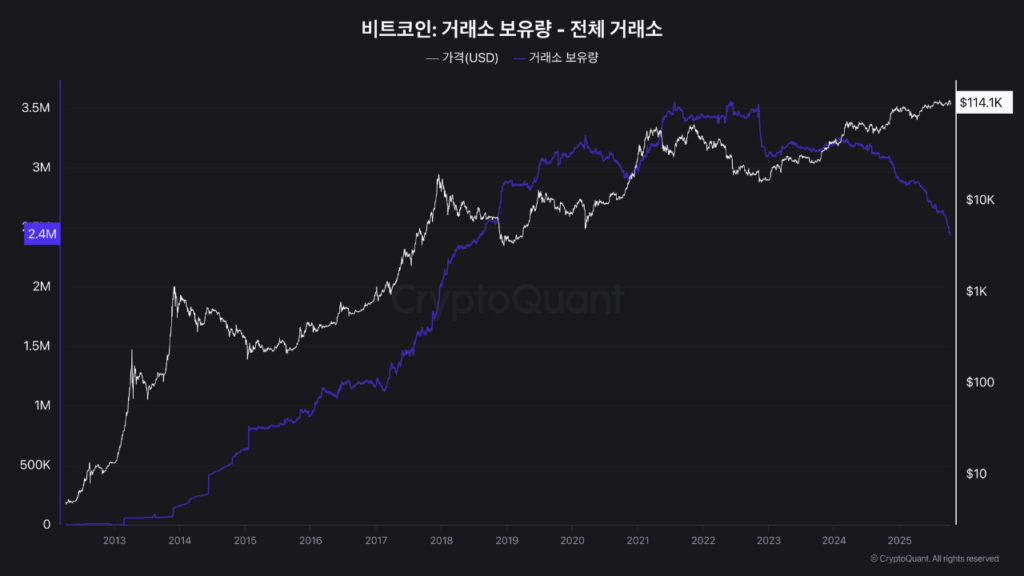
The reversal, which began in 2020, coincides with institutional adoption, growth in ETF custody, and long-term holder accumulation patterns. Fewer coins held on exchanges translates to reduced immediate sell pressure.
On-chain movement shows consistent withdrawals to cold wallets and institutional custody solutions. The same pattern preceded major bull runs in 2020 and 2021, when exchange outflows accelerated before price appreciation phases.
CryptoQuant’s analysis emphasized that “the available Bitcoin for trading is shrinking. Each outflow wave historically preceded large bullish impulses.”
The supply contraction creates conditions where incremental demand can drive outsized price movements, given the limited liquidity of the supply. The situation mirrors the setup conditions in 2020 before Bitcoin’s rally from $10,000 to $69,000.
$19B Leverage Wipeout Marks Reset Rather Than Capitulation
BTC faced its biggest leverage wipeout ever during the recent correction. Around $19 Billion in open interest was erased, according to Glassnode analysis.
Futures funding collapsed to levels last seen during the 2022 bear market. The rapid unwinding of leverage led to widespread liquidations and a sharp repositioning of the market.
Futures open interest contracted meaningfully, indicating a reduction in risk across derivatives markets. Realized profit-loss metrics indicate a period of loss realization and a cooling of sentiment among leveraged traders.
The options market saw open interest expand as traders repositioned around new volatility regimes. Glassnode emphasized that “the recent sell-off occurred with over 90% of Bitcoin supply still in profit, with most losses coming from top buyers.”
This observation differs from past major corrections, such as the FTX and Luna crashes. During those times, less than 65% of the Bitcoin supply remained profitable. The current event represents “not a broad capitulation but a structurally different, leverage-driven event.”
The distinction matters for the recovery trajectory. Leverage-driven corrections resolve quickly once excessive positioning is cleared, unlike capitulation events that require extended base building.
90% Supply Profitability Signals Structural Market Strength
Over 90% of the BTC supply remains in profit at the current $112,000 price levels. This shows the correction affected primarily recent top buyers rather than the broader base.
Profitability ratios eased from euphoric levels but still show a market dominated by profitable holders. The metric suggests strong support from long-term holders, who are unlikely to sell at current prices.
On-chain activity remains resilient, although it has moderated from its peaks. Fundamentals, capital flows, and profit-loss indicators continue rising modestly.
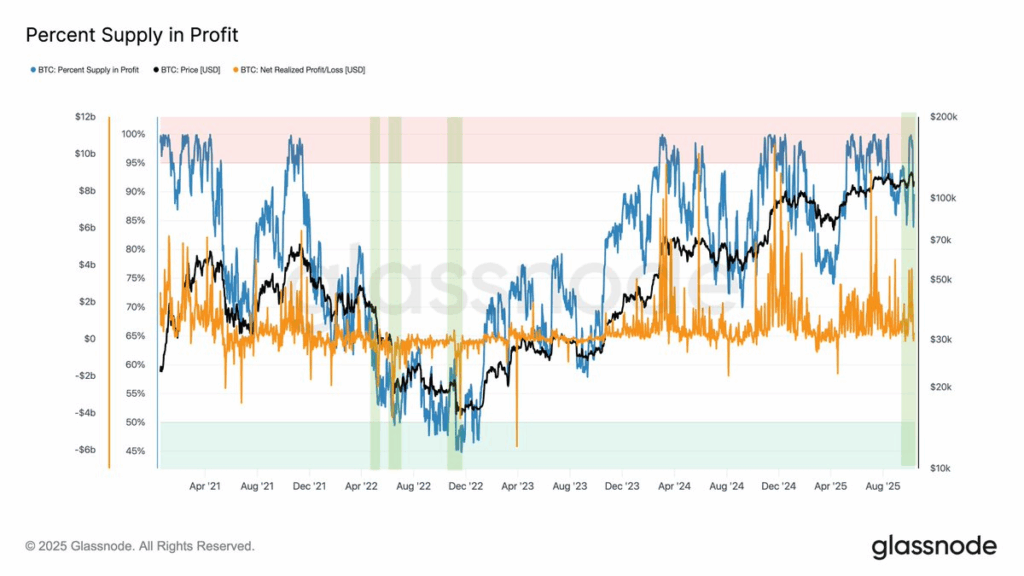
Glassnode concluded that “excess leverage has been cleared, speculative positioning reduced, and short-term sentiment recalibrated. While liquidity and broader market participation remain intact, momentum has slowed and profit-taking has cooled.”
Exchange reserves are at record lows, while supply profitability remains high. Together, these factors could support a return to the all-time high of $126,000.
Supply tightness limits the downside and removes speculative excess, clearing the path for a sustainable advance. Institutional ETF demand provides consistent buying pressure supporting gradual accumulation.
The question of whether Bitcoin can reclaim $126,000 depends on several catalysts. Historical patterns suggest that exchange reserve lows precede major rallies, as supply constraints amplify the impact of demand.



