
 astronaut
 Zylo Ecosystem
 Pearl
Pearl Quantus
 Bitcoin
 Sui
Sui Bitway
Wall Street tokenization moved from theory to policy after U.S. regulators cleared a key step. The Securities and Exchange Commission issued a no-action letter allowing the Depository Trust & Clearing Corporation to offer a tokenization service.
The approval covered stocks, bonds, and U.S. Treasuries already custodied by DTCC. Market participants treated the move as a formal regulatory acceptance of blockchain-based settlement.
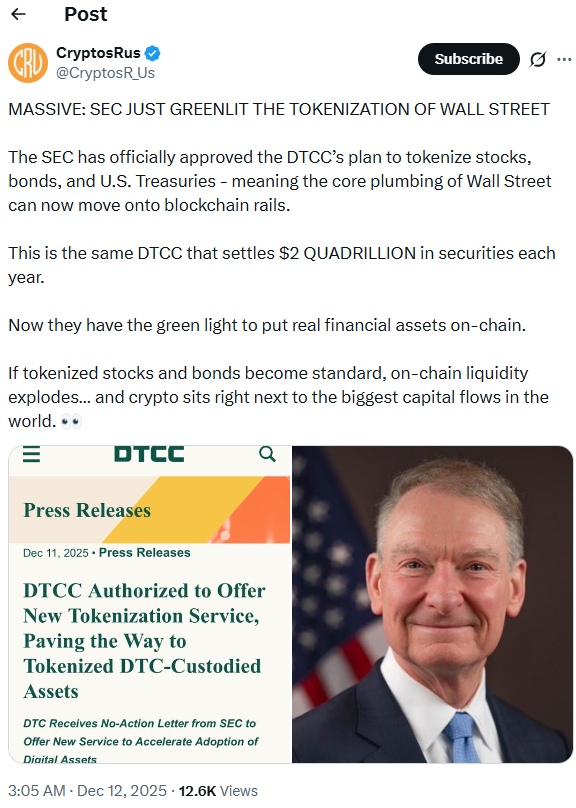
The decision mattered because DTCC sat at the center of global capital markets. The clearinghouse settled roughly $2 quadrillion in securities transactions annually, according to DTCC disclosures cited by CryptosRus.
By authorizing tokenized representations of these assets, regulators allowed core market plumbing to migrate onto blockchain rails. Wall Street tokenization shifted from pilot projects to regulated infrastructure.
SEC Signals Support for On-chain Market Structure
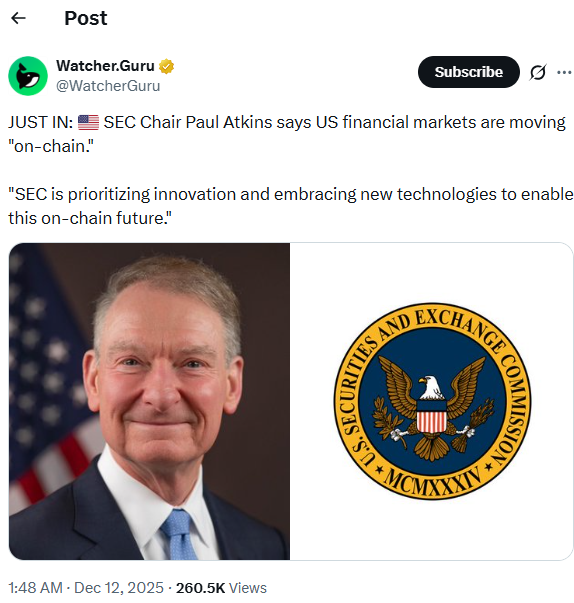
SEC Chair Paul Atkins framed the decision as part of a broader policy direction. He said U.S. financial markets were moving “on-chain,” according to Watcher.Guru.
Atkins added that the agency prioritized innovation and new technologies to support this transition. His remarks suggested internal alignment between market oversight and blockchain adoption.
The tone marked a contrast with previous regulatory skepticism. CryptosRus noted that DTCC received a no-action letter rather than enforcement scrutiny.
That distinction mattered because it reduced legal uncertainty for institutional adoption. Wall Street tokenization gained credibility as a sanctioned market activity rather than a regulatory edge case.
DTCC Tokenization Moves Beyond Pilot Stage
DTCC confirmed the scope of its new service in a press release shared by CryptosRus. The clearinghouse said it was authorized to accelerate adoption of digital assets tied to traditional securities.
The service focused on tokenized versions of DTCC-custodied instruments, not native crypto tokens. This structure kept the assets within existing custody and settlement frameworks.
That design choice reduced operational risk. DTCC did not replace its clearing role but extended it onto blockchain infrastructure.
By anchoring tokenized assets to regulated custody, the firm avoided questions about asset backing or settlement finality. Wall Street tokenization advanced without dismantling existing safeguards.
Market Reaction Centers on Liquidity and Scale
Crypto market commentators framed the approval as a catalyst for liquidity. CryptosRus stated that tokenized stocks and bonds could position crypto markets alongside the largest capital flows globally.
The argument focused on scale rather than speculation. If even a fraction of DTCC-settled assets migrated on-chain, blockchain liquidity would expand sharply.
Ash Crypto echoed that view, saying the SEC had approved DTCC’s request to tokenize stocks and bonds. He argued that trillions could flow into crypto-linked infrastructure as a result.
The comment reflected market optimism. However, it underscored expectations that regulated tokenization could attract institutional balance sheets.
ETF Filings Reflect Parallel Institutional Demand
Tokenization policy arrived alongside growing demand for regulated crypto exposure. Nate Geraci said there were 125 crypto-related exchange-traded fund filings before the SEC.
He cited data from James Seyffart to show the scale of applications. Geraci recalled skepticism about demand for Bitcoin exchange-traded funds and contrasted it with current filing volumes.
The surge suggested that institutions were positioning for broader access to the crypto market. Wall Street tokenization complemented this trend by expanding the asset base eligible for blockchain settlement.
The growth of exchange‑traded funds accelerated the connection between crypto and traditional finance. Tokenized securities strengthened this link further. Together, they signaled deeper integration between cryptocurrency infrastructure and mainstream financial systems.
Regulatory Personnel Shifts Add Momentum
Changes inside the SEC reinforced the policy shift. CryptosRus reported that Caroline Crenshaw, a vocal crypto critic, planned to leave the commission on Jan. 18.
Her departure reduced opposition to digital asset initiatives within the agency. The SEC would then operate with fewer commissioners publicly hostile to crypto markets.
Vivek Sen added another political dimension. He said the SEC chair announced on Fox that a Bitcoin crypto market structure bill was close to passage.
While legislative timelines remained uncertain, the statement aligned with regulatory signals favoring clearer rules. Wall Street tokenization benefited from this broader regulatory thaw.
Hybrid Tokenization and DTCC Integration in Market Infrastructure
Tokenized settlement promised operational efficiencies but raised new questions. Moving assets on-chain could shorten settlement cycles and improve transparency.
However, it also required robust governance around smart contracts and network reliability. DTCC’s involvement reduced counterparty risk but did not eliminate technical dependencies.
The approved model suggested incremental adoption. Assets remained under DTCC custody while blockchain handled representation and transfer.
This hybrid structure limited systemic disruption. Wall Street tokenization progressed as an extension of existing systems rather than a replacement.
What Markets Watched Next
Attention shifted to implementation details. Market participants tracked which blockchain networks DTCC would support and how interoperability would function.
They also watched whether additional asset classes would receive similar treatment. Each expansion would test regulatory comfort with on-chain settlement.
For now, Wall Street tokenization entered a regulated phase. The SEC’s no-action letter, DTCC’s service launch, and public comments from leadership formed a clear signal.
The next test lay in execution, not approval, as traditional finance began operating directly on blockchain infrastructure.




