Dacity Coin
 Pearl
Pearl Monad
Monad Aerodrome Finance
 Pump.fun
 Pudgy Penguins
 NeoSoul

Key Insights:
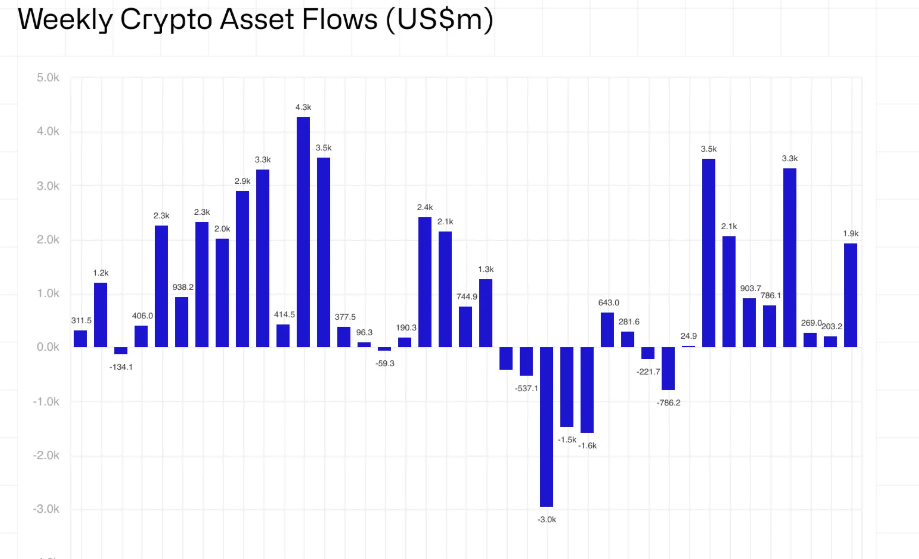
- Digital asset funds saw $1.9B inflows last week, marking nine consecutive weeks and $13.2B in YTD inflows.
- Bitcoin led with $1.3B in inflows, while Ethereum posted its strongest weekly inflow since February at $583M.
- XRP and Sui reversed outflows, attracting $11.8M and $3.5M in inflows, respectively, signaling renewed altcoin interest.
Digital asset funds saw a nine-week inflow streak continue, up $1.9 billion in the last week alone and bringing this year-to-date flows to all-time highs at $13.2 billion. This has boosted the demand by investors, given the increase in institutional action, and a rebound of major assets.
Bitcoin Leads Digital Assets Recovery with Weekly Inflows
Notably, Bitcoin was leading the weekly inbound, with an inflow of $1.3 billion in new investments. It is a considerable change after two weeks of small outflow and strengthens Bitcoin as a high-level digital asset product. The new influx was accompanied by the asset retaking the $107,000 level, driven by the renewal of corporate accumulation.
In addition, short-Bitcoin investment products, while smaller in scale, also recorded inflows totaling $3.7 million. However, assets under management in those products remain low at $96 million, indicating a broader preference for long exposure across investor classes.
Ethereum Registers Highest Inflows Since February
More so, Ethereum posted $583 million in inflows last week, its largest since February and the strongest single-day volume seen during this recent uptrend. With this gain, Ethereum’s recent inflow total reached $2 billion, representing 14% of total assets under management in Ethereum-based products.
Furthermore, Ethereum investments have seen consistent growth with a steadily growing interest. This is mainly after the recent transitions taking place in the network and the general advancements in layer-2 scaling. The positive flow also marked the end of a stagnation of the past and an indication of new institutional interest in Ethereum.
Across various providers, Ethereum-linked exchange-traded products (ETPs) and funds saw broad participation, contributing to rising weekly volumes. Analysts also noted that the strong performance in Ethereum flows aligns with rising network activity and fee generation.
XRP and Sui Attract Fresh Inflows After Previous Outflows
XRP received an inflow of $11.8 million following three weeks of net outflows. This shift indicates greater interest in the asset, which has continued to be the target of institutional and retail investors since the newfound legal certainty regarding its regulatory status in the United States.
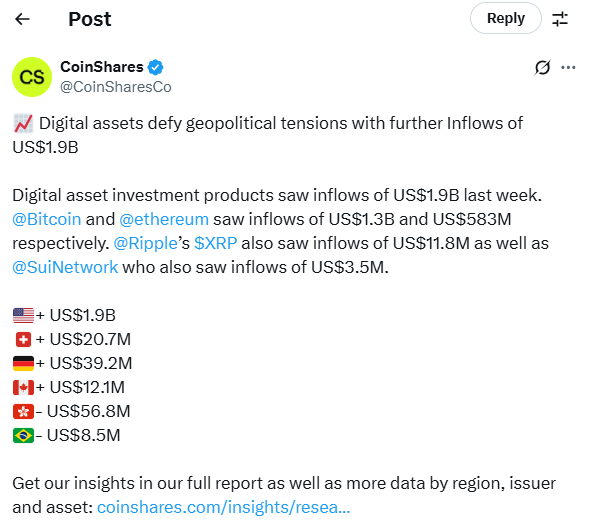
Sui, a Layer-1 blockchain, also posted $3.5 million in inflows for the week. The asset had previously seen muted interest, but the latest data points to a shift in sentiment as altcoin markets begin to attract selective capital inflows once again.
Moreover, the increase in altcoin flows has not yet recouped their early-cycle conditions, but a readiness to jump back into markets outside of Bitcoin and Ethereum is building among investors. This dip in XRP and Sui inflows may be an indication of pre-positioning on a wider altcoin rotation, depending on market circumstances.
Regional and Provider Data Show US-Led Inflows
Regionally, the United States led the inflow activity, accounting for nearly the entire $1.9 billion total. Switzerland, Germany, and Canada followed with $20.7 million, $39.2 million, and $12.1 million in inflows, respectively. These trends show that North America remains the primary driver of digital asset investment flows.
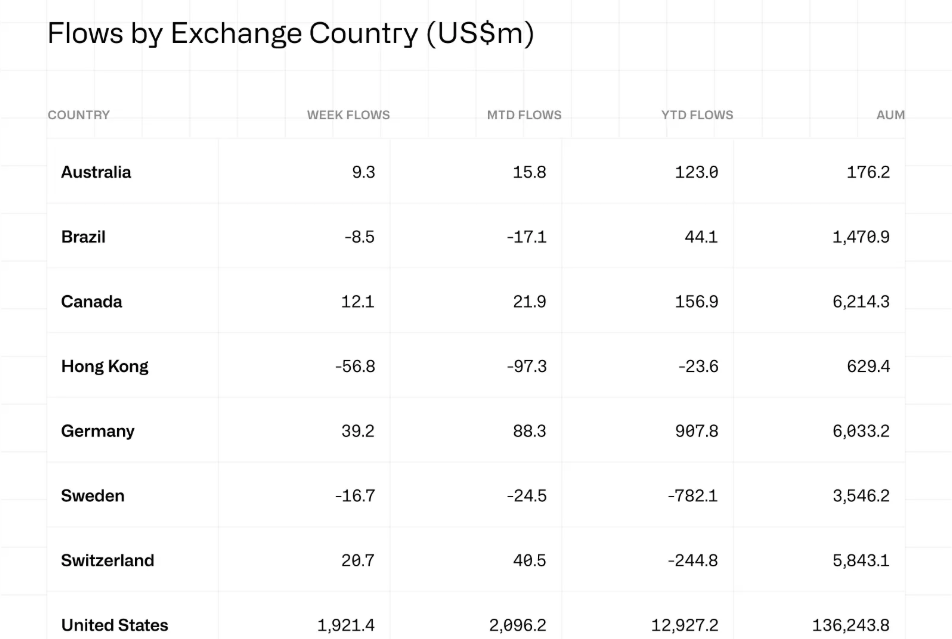
In contrast, Hong Kong and Brazil saw net outflows of $56.8 million and $8.5 million, respectively. The mixed regional data suggests differing investor sentiment across jurisdictions, with Western markets maintaining a more optimistic stance amid ongoing macro uncertainty.
Additionally, the flows led by institutional US-based providers were dominant in volume, whereas flows led by European funds were steady, though less in volume. On the provider level, the products were strongly involved in both physically-backed and derivative-based products.
Disclaimer
This article is for informational purposes only and provides no financial, investment, or other advice. The author or any people mentioned in this article are not responsible for any financial loss that may occur from investing in or trading. Please do your research before making any financial decisions.