Zerebro
 Bitcoin
 Aerodrome Finance
 ZKsync
 Pearl
Pearl Pudgy Penguins
 Bitway

The Federal Reserve injected $13.5 billion into U.S. banks overnight. Officials carried out the move on December 1, 2025. It marked the second-largest single-day injection since the COVID turmoil of 2020. The action even surpassed anything seen during the dot-com crash of 2000.
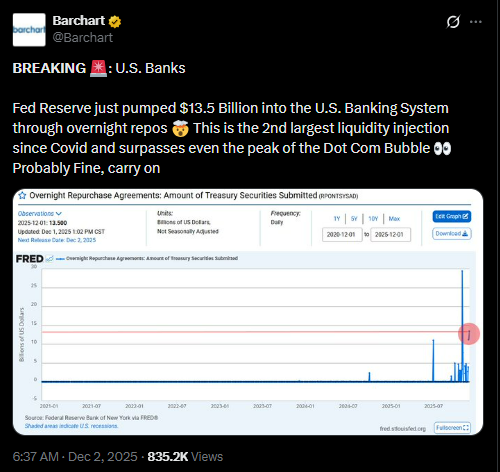
The news exploded across social media, with charts from FRED going viral. People wonder if the financial system faces real trouble. Others see it as routine market plumbing. The debate reflects the scale of today’s much bigger economy.
What Actually Happened on December 1?
The Federal Reserve gave primary dealers $13.5 billion in overnight cash. The move targeted the biggest banks and brokerages. In exchange, the banks handed over U.S. Treasury bonds as collateral.
The next morning, everything reversed. The banks returned the cash plus a tiny interest fee, and the Fed gave the bonds back. This tool is called an “overnight repo.” It is the Fed’s fastest way to calm short-term funding markets when banks suddenly need extra dollars.
The FRED series RPONTSYD records a sharp spike on December 1. It shows exactly $13.500 billion in overnight repo operations. The figure is confirmed, public, and undeniable.
Why Now? The Hidden Pressure on Bank Reserves
For the past two years, the Fed has been running “quantitative tightening” (QT). It allowed old bonds to mature without replacing them, thereby shrinking its balance sheet from almost $9 trillion to $6.57 trillion. That removed liquidity from the system intentionally to combat inflation.
QT officially ended on December 1, 2025, the very same day as the giant repo. At the same time, the U.S. Treasury has been issuing record amounts of new debt. All those new bonds soak up bank reserves like a sponge.
The result is that the reserves have fallen to the lower end of the Fed’s “ample” range, around $2.8–3.4 trillion. Month-end and quarter-end reporting dates add even more stress. Banks scramble for cash, rates spike, and the Fed intervenes with repos to maintain stability.
Bullish Signal or Warning Light?
Markets reacted fast. Crypto traders cheered “free money” and pushed Bitcoin above $94,000 in the hours after the news. Stock bulls called it a hidden stimulus. But not everyone is celebrating.
Analysts note the Treasury market has grown fourfold since 2000. That scale makes a $13.5 billion repo look modest. In relative terms, it is smaller than the dot-com era peaks. Others worry it echoes September 2019, when repo chaos forced the Fed to restart permanent money printing.
The truth sits in the middle. This single overnight operation is not QE and will vanish today. However, the size indicates that the system is tighter than many expected. If repo spikes continue to repeat, the Fed could shift to permanent reserves more quickly.
That move would inject lasting liquidity into markets. Stocks and crypto might surge as investors tap into the fresh fuel. For now, the Fed insists everything is “well within ample reserves.”
The viral FRED chart makes the point crystal clear. When the system suddenly needs $13.5 billion overnight, it signals stress. Someone, somewhere, was undeniably thirsty for dollars.