Pearl
Pearl Zylo Ecosystem
 Sui
Sui Starknet
 Pons
Pons NEAR Protocol
 Quantus

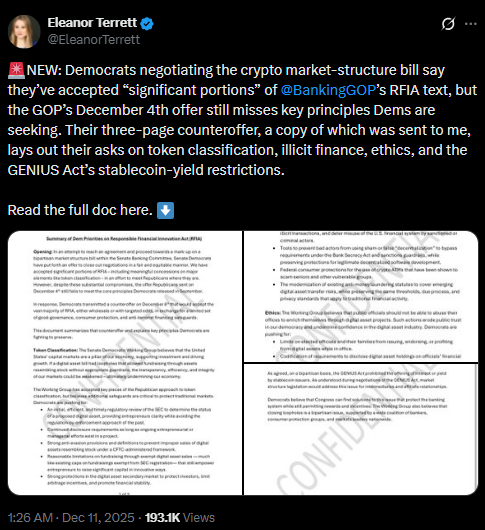
Senate Democrats have sent a three‑page counteroffer to Republicans negotiating the Responsible Financial Innovation Act (RFIA). Their proposal accepts major parts of the GOP draft. However, it demands stricter rules to protect markets, stop illicit finance, and enforce ethics standards.
The talks come as Chair Tim Scott pushes for a markup before the holiday recess. But Democrats say key issues remain unresolved. “We’re not ready for it. We’ve still got to work through illicit activity, money laundering issues that need to be addressed,” said Sen. Catherine Cortez Masto.
Democrats Seek Stronger Market and Investor Protections
Democrats say their counteroffer is a good‑faith effort to finish negotiations “fairly and equitably.” They accept the Republican approach to token classification. However, they want an initial SEC review to quickly classify new digital assets.
They say this gives clarity without “regulation‑by‑enforcement.” They want ongoing disclosure rules for active projects. Moreover, they want to stop stock‑like digital assets from avoiding SEC oversight.
Their plan includes caps on exempt fundraising that match existing SEC exemptions. They also call for stronger secondary-market protections to reduce arbitrage and maintain market stability.
Democrats argue the GOP draft weakens investor protections and could expose retirement savings to new risks. They say the RFIA must not undermine the core structure of U.S. capital markets.
Illicit Finance, National Security, and Ethics Rules
Democrats want tougher tools to stop terrorist financing, sanctions evasion, and large‑scale money laundering. They call for ways to isolate services used by bad actors like North Korea. Also, they want risk‑based tools to target major illicit activities.
Dems want requirements for platforms that allow access by sanctioned entities. They push for authority to address “false decentralization” under the Bank Secrecy Act.
Moreover, they want federal protections for consumers using crypto ATMs. These ATMs have been used to scam vulnerable groups.
They also want updates to anti-money laundering laws to cover new digital transfer risks without altering privacy thresholds. Democrats also propose ethics rules for public officials.
They want limits on elected officials and their families issuing, endorsing, or profiting from digital assets while in office.
Disclosure rules for officials’ crypto holdings are part of the proposal. The plan requires clear reporting of digital-asset interests. Promoters must reveal any compensation they receive. Stakes in assets must also be publicly disclosed.
They criticize what they describe as former President Trump’s firings of Democratic commissioners for political purposes. They call for full bipartisan slates at the SEC and CFTC to ensure stable rulemaking.
Stablecoins and the Road Ahead
Democrats want to keep the GENIUS Act’s ban on stablecoin issuers offering interest or yields. Such payments could pull deposits from community banks. This risk is highest for banks serving underserved areas, as mandated by the Community Reinvestment Act.
They say yields could also encourage risky behavior that threatens financial stability. They agree that intermediary and affiliate rules need improvement, but say Congress must strike a balance between innovation and banking protections.
Republicans say their December 4 offer was comprehensive and urge Democrats to compromise. Senator Cynthia Lummis and Kirsten Gillibrand remain hopeful for a revised draft.
But White House resistance to ethics and quorum language remains a challenge. “We have wide swaths where we don’t have agreement—even any language,” said Sen. Mark Warner.
If talks stall, the bill could slip into 2026. That would delay U.S. leadership in digital asset regulation as global competition grows.