
 streamoors
 IGNITION
 no crying in the casino
 Sword Inu
 Altai the Tiger
 NEAR Protocol
 Quantus
The Commodity Futures Trading Commission resolved its civil enforcement actions against Caroline Ellison and Gary Wang on Aug. 19.
A federal court imposed multi-year trading and registration bans on the former FTX-linked executives. The CFTC declined to seek additional restitution, disgorgement or civil monetary penalties after considering their cooperation and existing criminal forfeiture obligations.
CFTC Sets Multi-Year Trading Bans
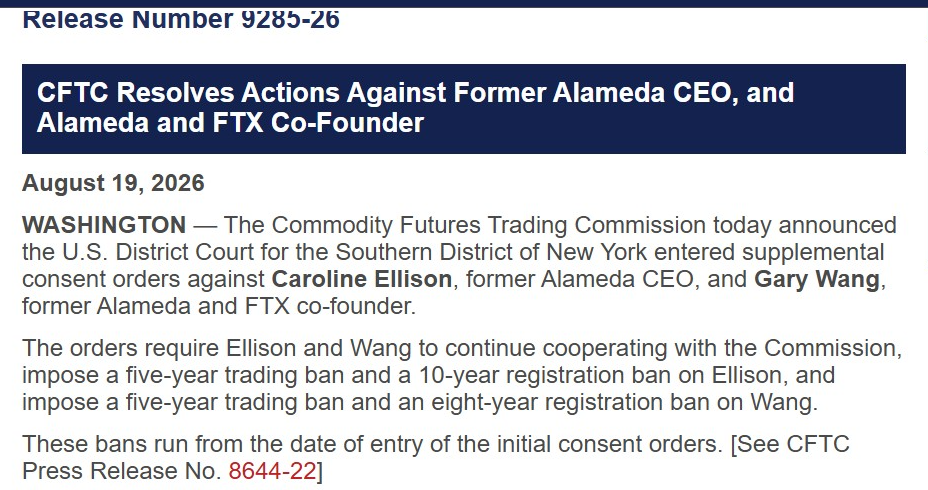
The U.S. District Court for the Southern District of New York entered supplemental consent orders on August 19. Caroline Ellison, the former Alameda Research CEO, received a five-year trading ban. The court also imposed a 10-year CFTC registration ban on her.
Gary Wang, an FTX co-founder and former Alameda executive, also received a five-year trading ban. His registration restriction runs for eight years. The restrictions date back to December 23, 2022, when the court entered the original consent orders against both defendants.
Those earlier orders found Ellison liable on two fraud counts in the CFTC complaint, while FTX co-founder Wang was liable on one fraud count. According to the crypto news, CFTC also permanently barred both from violating the antifraud provisions of the Commodity Exchange Act and related CFTC rules.
Crypto News: Cooperation Shapes CFTC Settlement Terms
The CFTC does not currently require Ellison or Wang to pay restitution, disgorgement, or civil monetary penalties. The regulator said their level of cooperation played a role in that decision. Both defendants must continue assisting the agency with its investigations and related proceedings.
Ellison and Wang also pleaded guilty to several federal criminal charges in December 2022. Those charges included conspiracy to commit commodities fraud. Their cooperation extended to criminal proceedings connected with the FTX case. The CFTC cited that assistance when explaining the sanctions included in the latest orders.
The regulator also cited an $11.02 billion forfeiture order from the related criminal cases. Ellison and Wang carry joint and several liability under that order. The CFTC considered those financial obligations alongside their assistance before settling its civil claims without additional monetary relief.
FTX and Alameda Faced a $12.7 Billion Order
The CFTC filed its original complaint against Sam Bankman-Fried, FTX Trading, and Alameda Research in December 2022. CFTC later added Ellison and Wang to the case. The regulator accused FTX and Alameda of misusing customer assets and making false statements to customers.
A federal court ordered FTX and Alameda to pay $12.7 billion in monetary relief in August 2024. The total included $8.7 billion in restitution and $4 billion in disgorgement. The CFTC said the money would support compensation for customers and other victims of the fraud.
The court also imposed injunctions against further violations of federal commodities laws. It placed trading and registration restrictions on the companies. The CFTC said FTX commingled customer funds and transferred assets for uses that customers had not authorized.
Caroline Ellison and Gary Wang Cases Now Resolved
The Aug. 19 supplemental orders complete the CFTC’s remaining civil claims against Ellison and Wang.
The resolutions differ from the corporate settlement because the regulator imposed no additional monetary sanctions.
Instead, the court imposed temporary trading and registration restrictions alongside permanent antifraud injunctions.
Ellison’s trading ban lasts five years from Dec. 23, 2022. Her CFTC registration restriction lasts 10 years from that date.
Wang’s trading ban also runs for five years. His registration restriction runs for eight years.
The CFTC previously used a similar approach when resolving its case against former FTX engineering chief Nishad Singh in April 2026. The regulator’s enforcement records show a supplemental consent order resolved that action.
The latest orders narrow the remaining FTX-related CFTC litigation after nearly four years of enforcement proceedings.
For Ellison and Wang, the civil cases now end without additional CFTC monetary penalties, but trading restrictions and cooperation obligations remain in force.



