astronaut
 Walrus
 Pearl
Pearl Bitcoin
 NEAR Protocol
 Zcash
Zcash Hyperliquid

Key Insights:
- Spot Bitcoin ETFs now account for over 30% of trading volume.
- Bitcoin and futures volumes dropped to lowest in over a year.
- Spot ETFs attracted nearly $50 billion in their first year.
Bitcoin ETFs post $80M daily inflow amid record dominance. Yet, spot and futures trading volumes hit year-low, diverging from BTC’s bullish price.
ETF inflows persist as BTC trading volume shrinks
Spot Bitcoin exchange-traded funds (ETFs) continued their strong performance on July 8, registering $80.08 million in net inflows, according to data shared by Wu Blockchain. None of the 12 listed spot ETFs saw outflows for the fourth day in a row.
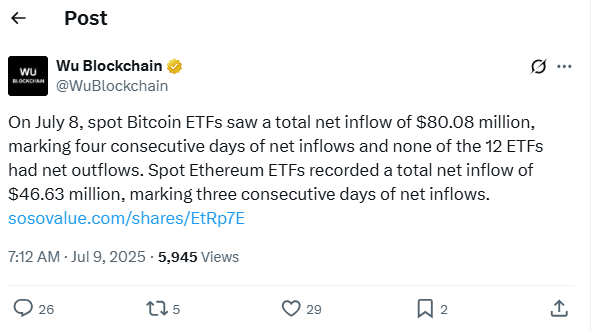
Ethereum spot ETFs followed with $46.63 million in net inflows, maintaining their own three-day streak. The data came from SoSoValue, which has tracked ETF momentum closely since their launch.
While prices remain near Bitcoin’s all-time high above $111,000, on-chain activity has diverged. Spot and futures market participation have dropped to their lowest levels in over a year.
Spot ETFs now control one-third of BTC volume
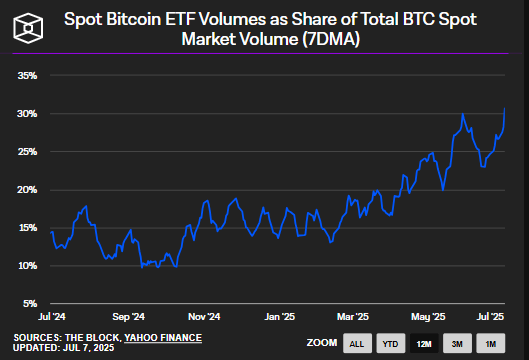
According to market data from The Block, spot Bitcoin ETFs now account for over 30% of total spot BTC trading volume. This share has risen rapidly since the U.S. Securities and Exchange Commission approved spot ETF listings earlier this year.
Traditional financial instruments have attracted capital from both institutional and retail investors. The products offer a regulated path to Bitcoin exposure, removing custody and compliance friction.
These funds have drawn nearly $50 billion in inflows in their first year of existence. SoSoValue estimates they now hold about $135 billion in total assets under management.
This shift has made ETFs a primary vehicle for Bitcoin access. It has also concentrated market flows into fewer hands, primarily institutions with direct on-chain activity, flattening.
Volumes hit 12-month lows despite BTC near all-time high
Despite the rise in ETF inflows, overall market volume continues to decline. Glassnode data shows Bitcoin spot volume dropped to $5.02 billion, while futures trading volume fell to $31.2 billion.
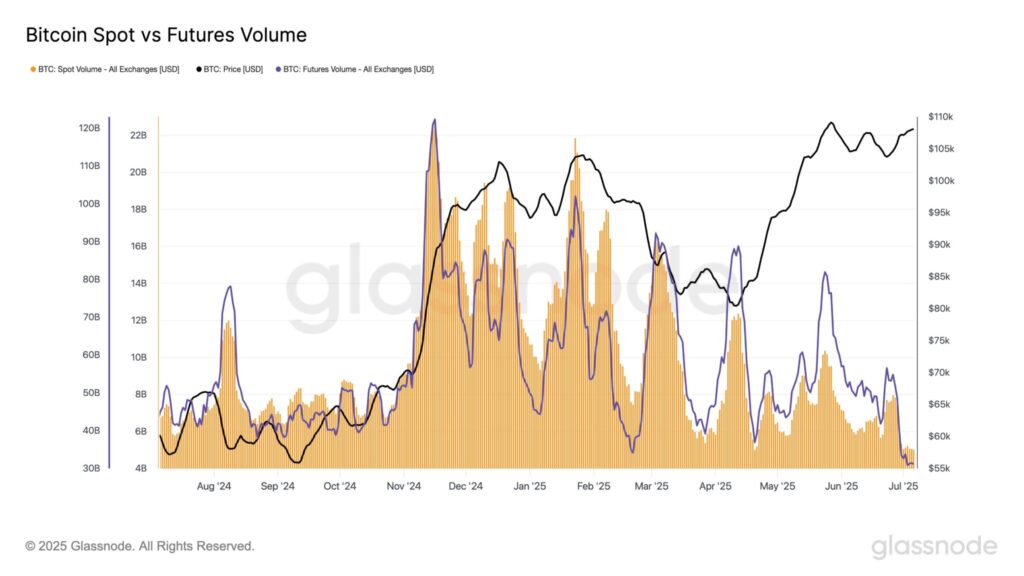
This represents the lowest combined activity in more than a year. Glassnode analysts noted that the trend has extended through multiple weeks, reflecting reduced speculative participation even as prices hold near cycle highs.
The divergence between price and volume highlights a market driven more by ETF flows than traditional retail trading. It also suggests that newer buyers may be less active on crypto-native platforms.
Institutions are leading, but activity remains fragmented
The current structure favors long-term investors over short-term traders. As ETF dominance grows, liquidity becomes more concentrated within these funds, while activity on centralized exchanges remains subdued.
This evolution introduces both stability and risk. On one hand, ETFs offer clearer regulation and more predictable inflow patterns. On the other, the shrinking share of decentralized trading raises concerns over market diversity.
So far, the trend shows no sign of reversal. ETF flows have remained consistently positive even amid broader market fatigue. With more spot products likely to launch in other jurisdictions, ETF-led trading could become the new normal.
Wu Blockchain underscored this shift by highlighting the sustained inflows across all Bitcoin ETFs, with not a single fund recording a net outflow since July 5.
Market awaits fresh catalyst as summer lull sets in
Bitcoin’s strong price performance continues to contrast with falling trading engagement. While ETF demand has propped up market cap, the absence of broader participation limits momentum for further upside.
Bitcoin could enter a prolonged consolidation phase if the pattern persists, driven by slow ETF flows rather than price volatility. The market appears stuck between high valuations and low conviction.
ETF growth has established a new trading paradigm. However, whether that structure can sustain a full bull cycle remains uncertain. Until volumes pick up or macro conditions shift, the ETF pipeline alone may not be enough to drive another breakout.
Disclaimer
This article is for informational purposes only and provides no financial, investment, or other advice. The author or any people mentioned in this article are not responsible for any financial loss that may occur from investing in or trading. Please do your research before making any financial decisions.