
 streamoors
 IGNITION
 Quantus
 Sui
Sui Pearl
Pearl Zcash
Zcash Aerodrome Finance

Asian stock markets suffered another technology-led sell-off on Wednesday as investors reduced exposure to semiconductor shares.
South Korea led the decline, with the KOSPI closing 6% lower. The index had fallen as much as 12.6% earlier in the session, triggering a market-wide circuit breaker for a second consecutive day.
Taiwan and Japan also recorded losses as concerns about elevated valuations and artificial intelligence spending spread across regional markets.
Market estimates put the combined decline in equity value across the three markets at more than $400 billion. The figure remains an estimate because market capitalisation changes with share prices and exchange rates throughout the session.
South Korea’s KOSPI Extends Its Historic Selloff
South Korea’s KOSPI dropped as much as 12.6% before recovering part of the decline. The index closed 6% lower after Tuesday’s fall of nearly 11%.
The exchange halted trading for 20 minutes after losses crossed the required circuit-breaker level. This move marked the second straight session with a market-wide trading halt. The session alone removed roughly $180 billion under one widely circulated market estimate.
The KOSPI has now fallen almost 40% from its peak, which was reached slightly more than one month ago. Low trading volume showed that buyers remained cautious during the steep decline.
Forced selling also increased as brokers closed leveraged retail positions. These trades had previously supported the rapid rise in South Korean technology stocks.
SK Hynix and Samsung Lead Losses in Seoul
SK Hynix reported a sixfold increase in profit, but its results missed elevated analyst expectations. Its shares fell nearly 20% during trading before closing 9.6% lower.
Samsung Electronics dropped as much as 14% before reducing its loss to 5.2%. The two companies represent more than half of the KOSPI’s total market value.
Investors had built large positions in both chipmakers during the artificial intelligence investment boom. Strong demand for advanced memory chips had supported their shares throughout the year.
However, the crowded trade left the market vulnerable when investors began reducing risk. The unwinding process accelerated as falling prices triggered more margin calls and forced sales.
Japan and Taiwan Follow the Regional Tech Decline
Taiwan’s stock market also weakened as investors sold major semiconductor shares. TSMC, the world’s largest contract chipmaker, fell 3.5% in Taipei.
The decline added pressure to the wider Taiwan market, which lost about 3% during the session. Market estimates placed Taiwan’s value loss at $110 billion.
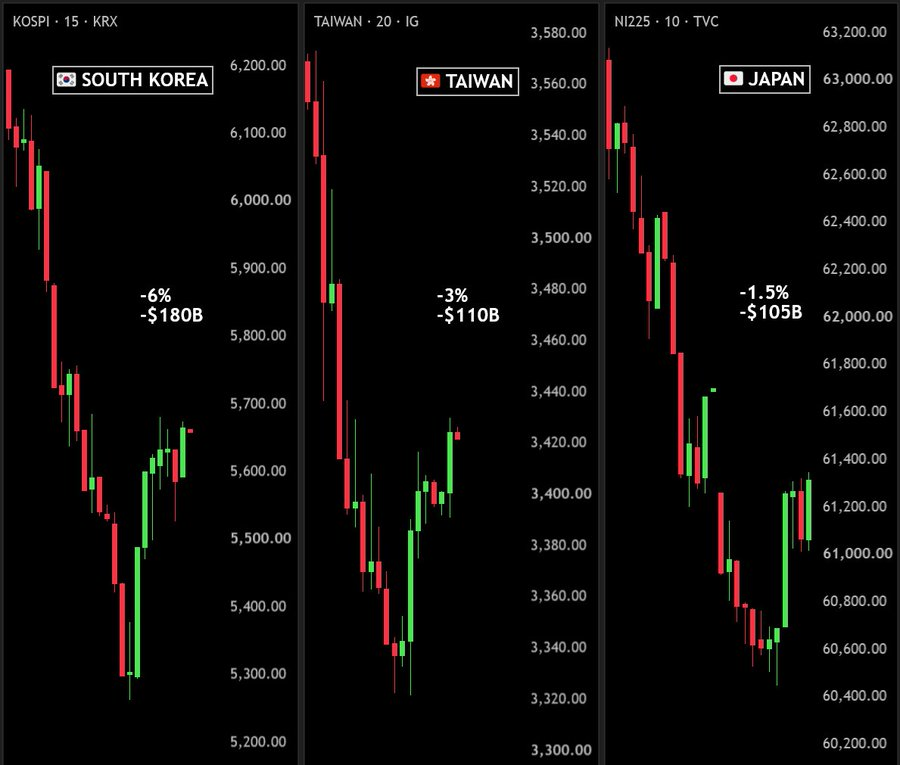
Japan’s Nikkei also moved lower as technology and semiconductor shares tracked the regional downturn. The benchmark fell around 1.5% during the selloff, erasing an estimated $105 billion.
Investors reduced exposure to companies linked to global chip demand and artificial intelligence spending.
The losses demonstrated how rapidly concerns in one major market can spread throughout Asia. Currency moves also changed dollar-loss estimates as local indexes recovered from intraday lows.
Leverage and High Valuations Deepen Market Rout
Leveraged retail trading intensified South Korea’s market decline. Single-stock leveraged ETFs magnify the daily movement of Samsung and SK Hynix shares.
Losses can therefore accumulate quickly when the underlying stocks fall sharply. South Korean authorities have acknowledged that the products contributed to increased volatility.
Finance Minister Koo Yun-cheol and Financial Services Commission Chairman Lee Eog-weon apologized for the policy allowing the products. They said officials had not adequately considered the risks before approving them.
The government had already announced measures covering single-stock leveraged ETFs and exchange-traded notes on July 16.
Those measures included stronger investor protections and tighter product-management requirements. It also involved restrictions on new offerings by firms that failed to meet the standards.
President Lee Jae Myung also ordered regulators to prepare further measures addressing the products’ effect on market stability.
Leveraged ETFs were not the only cause of the sell-off. Investors also responded to stretched technology valuations, rising borrowing costs, and concerns about returns from large artificial intelligence investments.
South Korea’s KOSPI Retains Strong Year-to-Date Gains
Despite the latest retreat, the KOSPI remained substantially higher for the year in U.S. dollar terms. The index had been one of the strongest-performing major equity benchmarks before the reversal.
Its rapid rise had been driven by Samsung, SK Hynix and wider expectations for continued artificial intelligence spending. The latest decline represented a sharp valuation reset rather than a complete reversal of the year’s earlier gains.
Further direction will depend on whether chipmakers meet future earnings expectations and whether regulators can reduce volatility from leveraged products.
South Korea remained the centre of the regional sell-off. However, declines in Taiwan and Japan showed that concerns about semiconductor valuations had spread across Asia.



