
 Sword Inu
 no crying in the casino
 streamoors
 IGNITION
 Altai the Tiger
 Pearl
Pearl Quantus
Hyperliquid’s founder has criticized centralized exchanges (CEXs) on the basis of what he claims to be massively underreported liquidation information.
The founder pointed out that all the trades, orders, and liquidations are processed in their entirety on the platform so that solvency of the system and actual trade execution can be publicly verified in real time.
The statement compares this model to the main CEXs, especially Binance. The founder alleged that the exchange downplayed the magnitude of liquidation events that users and the public were informed about.
He states that the fully onchain liquidations of Hyperliquid were not comparable to underreported CEX liquidations. In Binance, a situation may exist when there are thousands of liquidation orders within the same second, but only one is logged.
Since liquidations occur in bursts, in some cases, this may be easily 100x underreporting.
Record $19 Billion Liquidations Highlight Reporting Gaps
The comments are against the backdrop of increased volatility in the crypto markets after a historic liquidation of $19 billion in one day. That occurred due to new U.S. tariffs on China and the focus on the reliability and fullness of the information that is reported across platforms.
CoinGlass data recorded the biggest liquidation event in the crypto market’s history on October 10. This is due to an announcement by President Donald Trump that he will impose 100% tariffs on Chinese imports and also new restrictions on software exports.
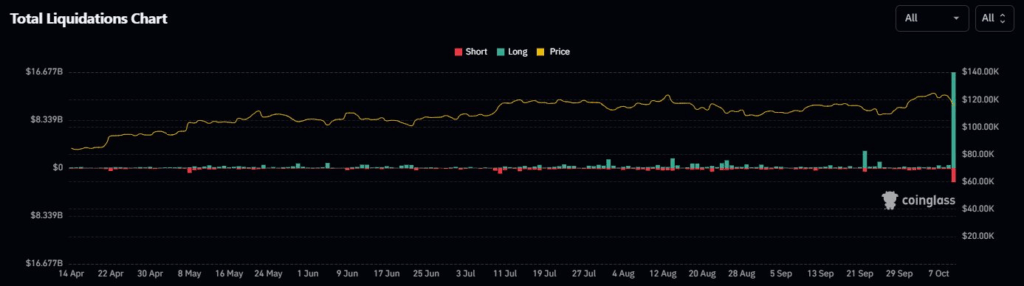
In a few hours, the price of Bitcoin, which had hit an all-time high of $125,000 days before, dropped drastically.
According to CoinGlass statistics, there are liquidations totaling 19 billion across exchanges. It revealed that over 1.6 million traders have been impacted, with nearly 7 billion positions being washed in a single hour.
The macroeconomic catalyst of the event was evident. However, the choice of liquidation reporting on various trading platforms remains questionable.
As pointed out by analysts, on-chain platforms such as Hyperliquid, where all liquidations are verifiable through blockchain records, offer a greater level of transparency than centralized venues, where internal reporting practices may differ.
Tariffs, Volatility, and Institutional Leverage Hit Backdrop
The crypto market has been influenced by traditional economic policies. Besides, the liquidation rush was in a larger context of macroeconomic tension between the United States and China.
The oil and cryptocurrencies collapsed significantly due to the announcement of the tariff, as was reported by Bloomberg. Investors shifted their focus to gold and U.S. Treasurys instead.
The sell-off was initiated by no more than the fear of U.S.-China tariffs but was short-changed by institutional over-leverage. It implied that an institutional high-risk derivative position complicated the scale of the losses.
This confirms the mounting opinion that cryptocurrency markets are highly entangled with global liquidity and risk sentiment. It makes the availability of credible and transparent reporting even more vital in times of stress.
Regulatory and Institutional Shifts Toward Transparency
The liquidation controversy is part of the broader institutional and regulatory shift toward greater accountability in digital finance.
More recently, regulators, including the Bank of England, have been considering models where stablecoin reserves are recognized as viable balance-sheet assets. It embodies the mainstream adoption of tokenized finance.
Likewise, the fact that U.S. Bank held the reserves of stablecoins used by the payment network of Anchorage Digital Bank indicates convergence between conventional finance and the infrastructure of digital assets.
JPMorgan analysts, who believe crypto is currently in a Napster era, estimate that the proliferation of stablecoin use would add up to $1.4 trillion of dollar demand by 2027. They associate the management of reserves with the international liquidity flows.



