
 astronaut
 Pearl
Pearl NEAR Protocol
 Starknet
 Zcash
Zcash Pudgy Penguins
 Ethena

Alon Muroch, CEO of SSV Labs, shared a key structural difference between the Ethereum (ETH) and Tempo blockchains.
His comments coincide with a developer transitioning from Ethereum to the Tempo blockchain. Meanwhile, the ETH price is showing signs of a potential rally towards the $4,000 level.
Why Tempo is Different from Ethereum
Muroch pointed out a huge difference between ETH and Tempo in response to a post on X. The X user claimed Tempo is bearish for ETH, adding that Stripe and Paradigm may have given ETH its death sentence.
Responding to the post, Muroch described Tempo as a for-profit, company-owned blockchain controlled by fintech giant Stripe. The CEO emphasized that Tempo is designed to serve the business interests of Stripe.
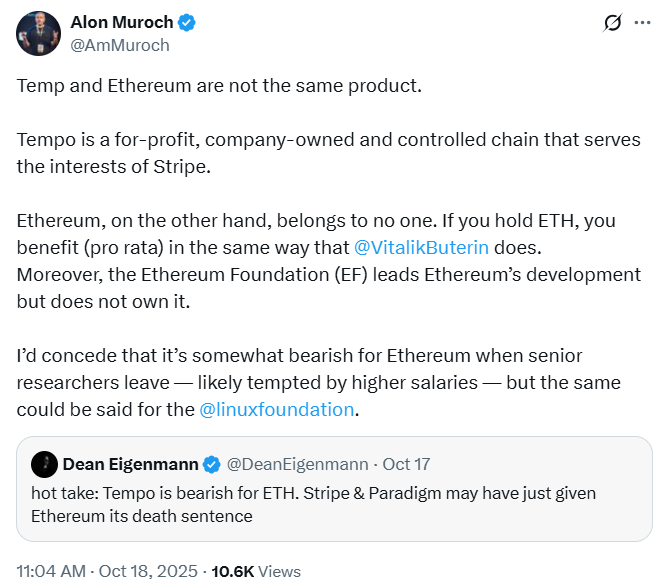
In contrast, he noted that Ethereum is a decentralized blockchain not owned by any single entity. Muroch explained that Ethereum belongs to its community. There, holding the asset gives investors a proportional stake in the network, similar to co-founder Vitalik Buterin.
Muroch also clarified that the Ethereum Foundation (EF) leads development but does not own the network. Furthermore, Muroch acknowledged that Ethereum may face challenges when senior researchers leave, possibly for better-paying opportunities elsewhere.
He views this as “somewhat bearish” for Ethereum, as losing talent could slow development or innovation. However, the CEO thinks researchers’ exit from ETH is similar to other open-source projects like Linux.
The key takeaway from Muroch is that Tempo serves Stripe’s commercial goals. At the same time, Ethereum focuses on decentralized ownership and community governance.
Tempo Boosting Developer Base
The comments from Muroch follow an announcement from developer Dankrad Feist about leaving the EF research team to join Tempo. Taking to the X platform, Dankrad expressed excitement about joining Tempo.
He views the past year as a pivotal moment for crypto, where early visions are coming to fruition. Dankrad said payments were a core focus in crypto’s early days, and Tempo represents a unique opportunity to realize this goal.
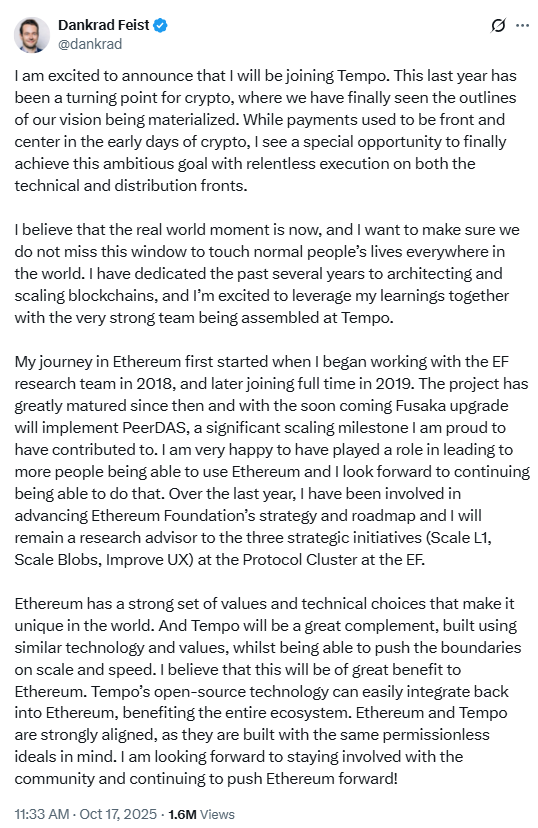
He went on to outline his history with Ethereum, starting in 2018 with the EF research team and joining full-time in 2019. The researcher acknowledged that the Ethereum project has matured greatly over the years.
He also views the upcoming Fusaka upgrade, which includes PeerDAS, as a key scaling milestone for Ethereum. Despite moving to Tempo, Dankrad will remain a research advisor to the EF Protocol Cluster. He would keep supporting the same three strategic initiatives.
Dankrad claims both Ethereum and Tempo are aligned in their permissionless ideals and built with similar technologies and values.
Ethereum Liquidity Clusters to Watch
Amid the discussions about Ethereum and Tempo blockchains, analyst Ted Pilliows has spotlighted key liquidity clusters to watch for ETH. In crypto trading, liquidity clusters refer to a price range where a large amount of buy and sell orders are concentrated.
For ETH, Ted Pillows highlighted liquidity clusters between the $4,400 and $4,800 range. If the ETH price reaches this cluster, it could absorb the liquidity, potentially leading to a breakout.
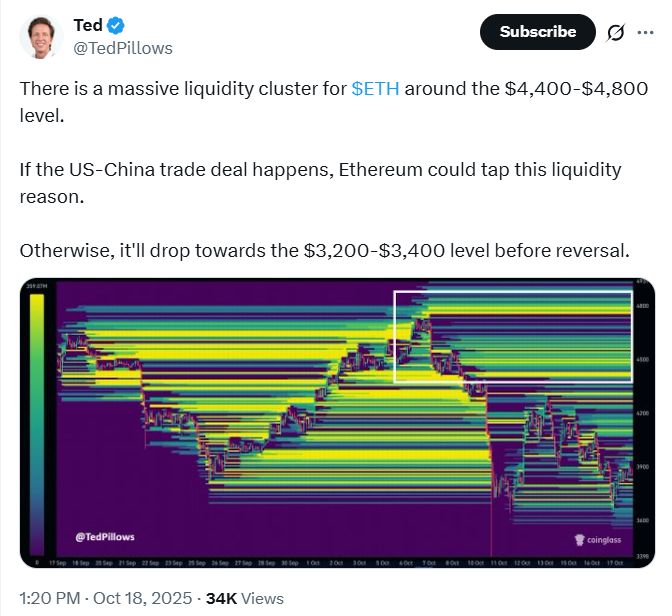
Ted Pillows sees a possible trade deal between the U.S. and China as the bullish catalyst for ETH to tap $4,400-$4,800. Essentially, trade resolutions reduce global uncertainty, boost risk-on sentiment, and historically lift assets like ETH.
The analyst also pointed out a bearish base case, around $3,200-$3,400 level, if both countries fail to reach a trade deal. At press time, ETH is traded at $3,876, up 1.3% in the past 24 hours and 0.8% over the past week.
Ethereum hit its ATH of $4,946 in August but has trended lower since. The decline was influenced by the broader crypto cooldown following a historic market crash.





