
 astronaut
 Pearl
Pearl NEAR Protocol
 Walrus
 Zylo Ecosystem
 Bitcoin
 Hyperliquid
Nvidia stock fell sharply from its record high of $236.60 toward $196.
The pullback accelerated as investors reduced exposure to semiconductor and artificial intelligence infrastructure companies.
Reports about Nvidia’s possible role in financing a large OpenAI data centre also increased concerns about circular funding across the chip sector.
Focus now shifts toward earnings from Nvidia’s largest customers. Their capital expenditure guidance could shape the next NVDA stock move.
Nvidia Stock Drops as Chip Rout Continues
NVDA stock is in a deep dive as investors dump semiconductor and memory companies that have driven the US, South Korean, and Japanese markets higher this year.
In South Korea, companies like Samsung and SK Hynix have plunged by over 40% from their highest levels this year. Similarly, in Japan, companies like Kioxia and Advantest have all dived in the same period.
Most notably, ETFs tracking semiconductor companies have also dropped. The iShares PHLX SOX Semiconductor Sector Index Fund (SOXX) has dropped to $494 from the all-time high of $655. The VanEck Semiconductor ETF (SMH) has also fallen from $672 to the current $540.
There are several reasons why the stock is in a strong free fall this year. For example, there are concerns about the ongoing circular financing cycle. This is a situation where Nvidia invests in companies that then become its clients. It has invested in some companies like OpenAI, CoreWeave, Nebius, and IREN.
Just this week, it was reported that Nvidia is backing OpenAI’s Ohio data center in a project worth over $250 billion. It has also invested $30 billion in OpenAI and has committed $10 billion in Anthropic, the creator of Claude.
Meanwhile, there are concerns about the growing market share of Chinese AI models like Qwen and Kimi. Moonshot recently released Kimi K3, which has become the biggest AI model. The risk is that many companies, including in the United States, will start using Chinese models that are equally good.
Nvidia’s stock also dropped as some of its biggest investments fell. Corning, which Nvidia invested $3.2 billion in, has dropped by 56% from its all-time high. Other companies like IREN, CoreWeave, and Nebius have all plunged.
Big Tech Earnings Coming Up as Profitability Growth Continues
Nvidia stock has dropped sharply in the past few weeks as investors remain concerned about the profitability of its customers.
Its top clients, like Microsoft, Amazon, Alphabet, and Meta Platforms, plan to spend over $720 billion this year. They plan to spend over $5.3 trillion on capital expenditure by 2030. Most of this spending will be financed by debt and equity.
As such, there is a risk that these companies will start reducing their capital expenditures. For example, Google stock plunged last week after the company boosted capital expenditures to $205 billion.
Therefore, Nvidia stock will be in the spotlight as its top clients publish their financial results. These companies, including Microsoft, Meta, Amazon, and Apple, will release their numbers this week. Their numbers will be important as they will provide color on their capital expenditure plans.
NVDA Stock Price Technical Analysis
The four-hour chart showed Nvidia stock falling from $236.60 toward $196. NVDA appeared to form a small double-top pattern around its July 15 and July 22 highs.
A double top contains two peaks near the same level. Traders usually consider the formation bearish after price closes below its neckline.
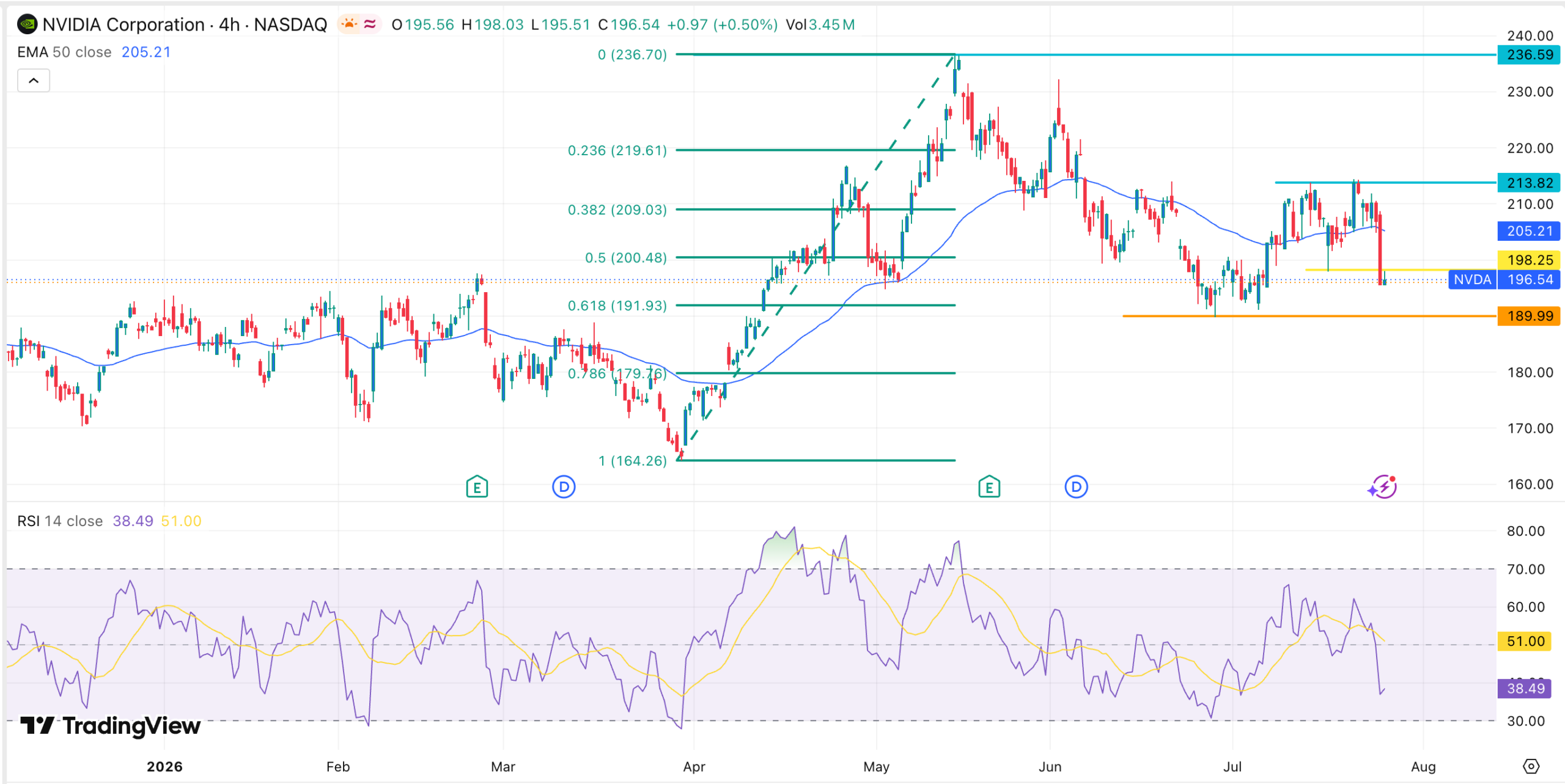
Nvidia stock moved below the neckline near $198. That break strengthened the short-term bearish setup.
NVDA also fell beneath the 50% Fibonacci retracement level. It traded below its 50-period exponential moving average.
The Relative Strength Index moved below the neutral level of 50. That reading showed weakening momentum without confirming an oversold condition.
The first downside target sits near $190. That level marked a previous June support area and aligned with the 61.8% Fibonacci retracement.
A sustained break below $190 could expose deeper support. Traders would then watch the previous recovery base.
However, the pattern remains vulnerable to invalidation. A move back above $198 would weaken immediate selling pressure. Nvidia stock would require a sustained close above $213 to invalidate the double-top setup.
Big Tech earnings remain the next major catalyst. Stronger cloud growth and continued capital spending could support NVDA. Weaker spending guidance could strengthen the bearish technical structure.



