Dacity Coin
 Celestia
 Pudgy Penguins
 Injective
 Solana
 Sui
Sui Starknet

Bitcoin (BTC) traded around $113,000 on Oct. 29 as traders assessed the impact of a market-wide reset in leverage. Funding rates turned positive again after a sharp wipeout earlier in the month, hinting at renewed bullish momentum.
According to data shared by CryptosRus, “Negative funding just wiped the market clean. Leverage flushed, shorts got paid, open interest cooled off — it’s the reset we needed.” The analyst added that every time funding flipped positive after such a reset, Bitcoin historically began “building momentum again.”
Funding Flip Points to Fresh Upside
The derivatives market appeared to be stabilizing following a sharp contraction in open interest last week. Since Oct. 22, Bitcoin’s funding rates climbed back above zero, signaling that long positions once again dominated futures markets.
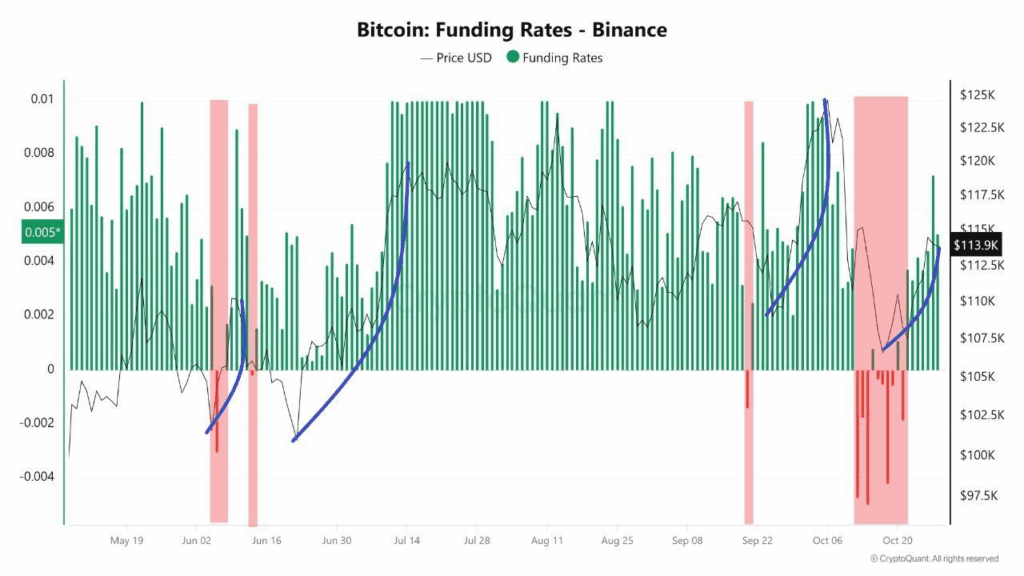
That shift mirrored similar recoveries seen in June and September, when renewed positive funding preceded notable price rebounds. “It’s a quiet sign that traders are turning long again while price is still consolidating,” CryptosRus noted.
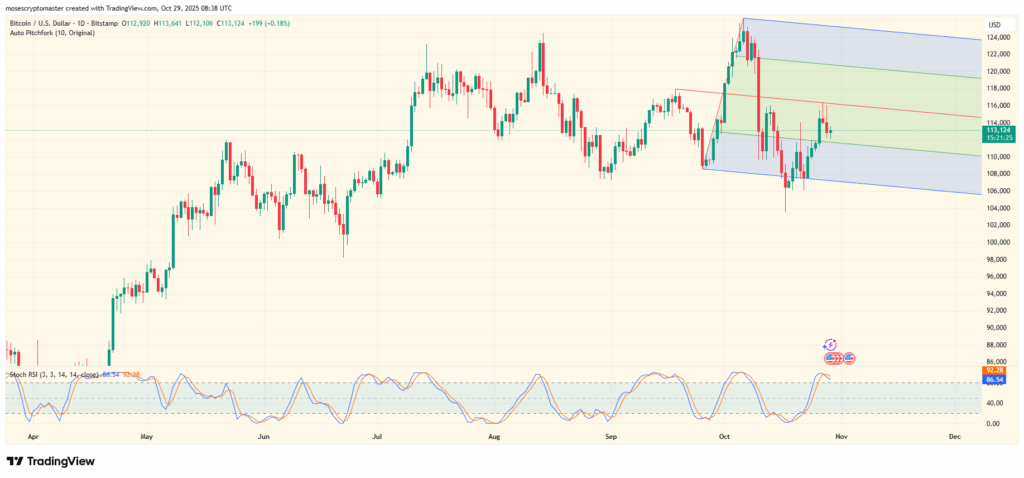
Data from TradingView showed BTC/USD hovering near $113,380 at press time, up 0.4% on the day. The daily chart indicated that Bitcoin remained within a descending pitchfork channel, capped by resistance around $116,000 and supported near $110,000.
Nasdaq Hits Record as Bitcoin BTC Lags
Elsewhere, macro conditions provided a contrasting backdrop. Ash Crypto pointed out that “Nasdaq futures just hit a new all-time high while Bitcoin dumped to $112K,” calling it “manipulation at its finest.”
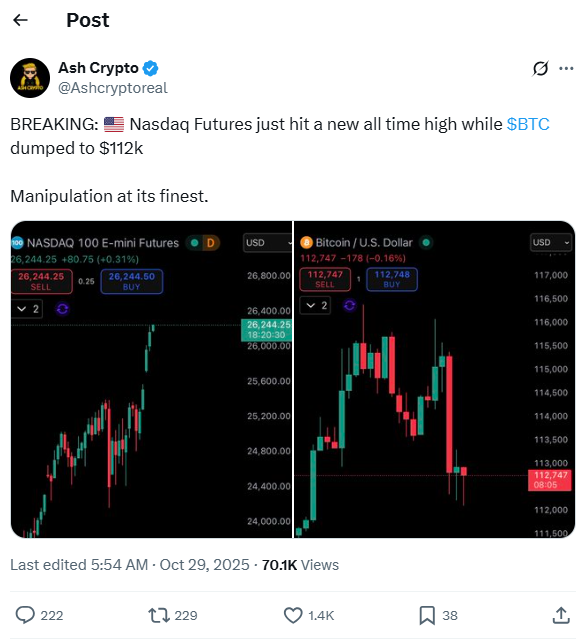
This divergence between traditional equities and crypto markets drew attention from analysts watching correlations between risk assets. Historically, Bitcoin often tracked U.S. stock indices during periods of high liquidity, but its lag this week suggested selective risk appetite.
The broader market appeared cautious amid tightening trade conditions. As CRYPTOHELL highlighted, “Tariffs up 155%: threat or opportunity for Bitcoin?” The comment referred to a recent U.S. import tariff hike, which could reshape global liquidity flows and indirectly influence digital asset markets.
On-Chain Data Suggests Accumulation
Despite macro headwinds, on-chain signals showed a different narrative. CRYPTOHELL reported that Bitcoin and Ethereum (ETH) exchange netflows have remained negative since mid-October, indicating that investors have continued to move coins off exchanges a pattern typically linked to accumulation rather than selling.
“Exchange netflow (BTC & ETH) has shown consistent outflows since mid-October,” the post explained. “This typically reflects quiet accumulation by smart money, not panic selling.”
Meanwhile, Tether (USDT) exchange netflow data showed consistent inflows throughout October, with several billion-dollar spikes mid-month. That suggested liquidity remained available for potential dip-buying, even as sentiment cooled.
The Miner Position Index (MPI) also remained low, indicating that selling pressure from miners remained minimal. Historically, miners holding through uncertain conditions often reflects long-term confidence in Bitcoin’s value proposition.
CME Gap Partially Filled as Traders Eye Next Move
Another element influencing short-term sentiment came from futures markets. Max Crypto noted, “$BTC CME gap got partially filled today. In the past four months, Bitcoin has filled every CME gap within two weeks.”
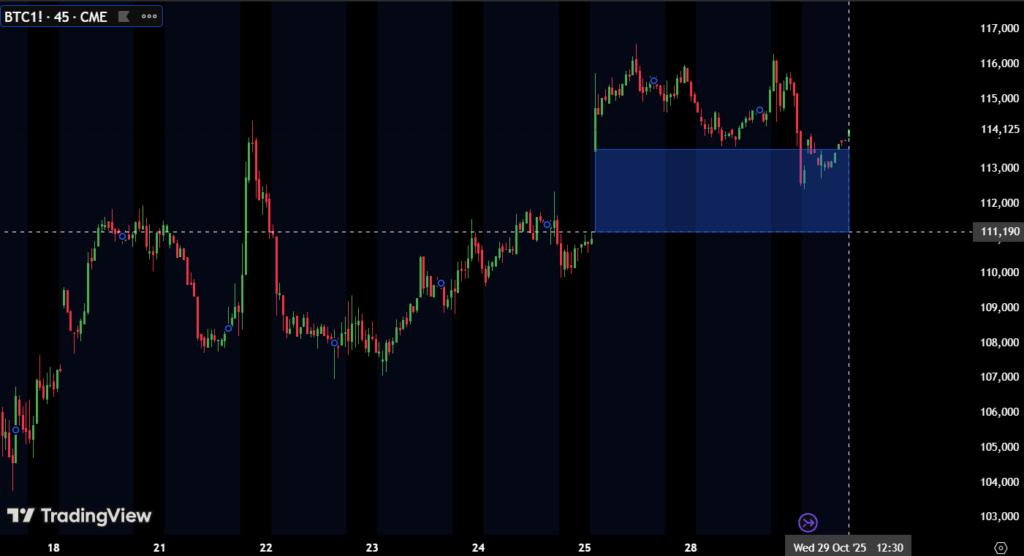
The CME gap, the price difference between Bitcoin’s Friday close and Monday open on Chicago Mercantile Exchange futures, has historically acted as a magnet for spot price movement. The partial fill near $112K aligned with previous patterns where Bitcoin revisited unfilled gaps before resuming trend movement.
Technical indicators reinforced this cautious optimism. The Stochastic RSI on the daily timeframe sat near 87, suggesting the market remained overbought but still within a potential continuation zone if momentum strengthened.
Market Outlook: Calm Before the Breakout
Analysts described the current structure as a “calm before the next big move.” With leverage flushed, funding positive, and liquidity re-entering the system, market participants expect volatility to return soon.
“Every single time funding flips positive after a deep reset, Bitcoin starts building momentum again,” CryptosRus emphasized. That cyclical pattern, combined with ongoing exchange outflows and low miner pressure, suggests that Bitcoin may be preparing for a medium-term recovery.
Still, caution dominated sentiment as macro uncertainty loomed. Rising tariffs, a stronger U.S. dollar, and shifting liquidity dynamics may continue to weigh on risk appetite. Yet the resilience of on-chain accumulation hinted that large holders remained unfazed by short-term volatility.
For now, Bitcoin’s key range lies between $110,000 and $116,000. A daily close above $116,000 could trigger renewed bullish momentum toward $120,000, while losing $110,000 may reopen downside tests near $106,000.
As of writing, Bitcoin’s market structure reflected consolidation rather than capitulation — a phase that, as history shows, often precedes renewed strength once traders regain confidence.